Part I – What's so unique about their geology?
Part II – What do we know about their geological evolution?
Part III - Climbing the Geology of the High Peaks
This early 1900's postcard depicts Lake Colden from Avalanche Pass in the High Peaks Region of the Adirondacks of northern New York State. Lake Colden is the first of three spillover-lakes that reside in a post-Pleistocene, glacially-scoured, fault-bounded valley between sheer cliffs of Middle Proterozoic Grenville metanorthosite.

On the first day of our geological exploration in the High Peaks Region, my daughter and I ascended Mount Wright and Mount Algonquin, the latter being the highest peak in the MacIntyre Range and second highest in the state. To visit that post, click here. On this day, we explored the waterforms immediately east of the MacIntyres.
FINDING FAULT
During the assembly of the supercontinent of Rodinia, Middle Proterozoic Grenville orogenic events laid a foundation of metanorthosite and associated rocks throughout the region. Many of the NE-striking faults within that basement may have begun as normal faults in the extensional environment that existed during the closing stages of the orogeny.
During the assembly of the supercontinent of Rodinia, Middle Proterozoic Grenville orogenic events laid a foundation of metanorthosite and associated rocks throughout the region. Many of the NE-striking faults within that basement may have begun as normal faults in the extensional environment that existed during the closing stages of the orogeny.
The faults that persisted within the Adirondacks were likely reactivated (and new ones created) during Paleozoic Alleghenian tectonic collisions, specifically during overthrusting of the Taconic Orogeny. Late Cretaceous thermal doming of the region of the future Adirondacks subsequent to passage over the Great Meteor hotspot also may have reactivated the faults. These events, from the Middle Proterozoic through the present, are explained in greater detail in my post Part II here. Today, the myriad of NE-SW faults influence the orientation of many of the ranges and waterways within the High Peaks Region.
THE BIG PICTURE
The following three-photo panorama faces south towards the High Peaks. It shows the relationship of the NE-trending MacIntyre Range to fault-bounded Avalanche Pass on the east and Indian Pass on the west. The open flat in the foreground is a small portion of a post-glacial, dry lakebed called South Meadows. Many large lakes such as this were breached when their ice and morainal dams catastrophically broke open. Our trek to the lakes via Avalanche Pass began at Heart Lake, at the base of Mount Jo.
The following three-photo panorama faces south towards the High Peaks. It shows the relationship of the NE-trending MacIntyre Range to fault-bounded Avalanche Pass on the east and Indian Pass on the west. The open flat in the foreground is a small portion of a post-glacial, dry lakebed called South Meadows. Many large lakes such as this were breached when their ice and morainal dams catastrophically broke open. Our trek to the lakes via Avalanche Pass began at Heart Lake, at the base of Mount Jo.

You can also see the fault-trending relationships aerially on this image captured from Google Earth.

ASCENT TO MARCY DAM AND POND
At sunrise, we departed from the Adirondack Loj (spelled correctly) at Heart Lake (elevation 2,169 feet). After a two-mile upward grade, we reached Marcy Dam and its impounded Marcy Pond (elevation 2,346 feet). In 1999 Hurricane Irene wiped out a footbridge that crossed the dam, which was rebuilt downstream across Marcy Brook. The dam replaces one first built for the logging industry at the turn of the previous century.
At sunrise, we departed from the Adirondack Loj (spelled correctly) at Heart Lake (elevation 2,169 feet). After a two-mile upward grade, we reached Marcy Dam and its impounded Marcy Pond (elevation 2,346 feet). In 1999 Hurricane Irene wiped out a footbridge that crossed the dam, which was rebuilt downstream across Marcy Brook. The dam replaces one first built for the logging industry at the turn of the previous century.
 |
| A wooden, weather-beaten Marcy Dam without its footbridge impounds brook trout-stocked Marcy Pond at low stage. |
LEGACIES OF THE PLEISTOCENE
The waters of Marcy Pond are a small part of the St. Lawrence Watershed. They flow north to Lake Champlain and the St. Lawrence River, the widest river in the world and a major shipping lane between the Great Lakes and the Atlantic Ocean. The Adirondack’s watersheds and their respective waterforms formed subsequent to the most recent recession of the Laurentide continental ice sheet in the Pleistocene about 16,000 years ago.
The waters of Marcy Pond are a small part of the St. Lawrence Watershed. They flow north to Lake Champlain and the St. Lawrence River, the widest river in the world and a major shipping lane between the Great Lakes and the Atlantic Ocean. The Adirondack’s watersheds and their respective waterforms formed subsequent to the most recent recession of the Laurentide continental ice sheet in the Pleistocene about 16,000 years ago.
Late Cretaceous uplift responsible for the creation of the Adirondack range initially established a radial stream pattern in the mountainous, elliptical dome that formed. With subsequent downcutting to erosion-resistant, anorthositic bedrock, Grenville-age faults began to dictate the pattern of flow. Today, still radial on a grand-scale, a trellis pattern follows the many linear fault zones with lakes, rivers and streams directing their waters ultimately to the Atlantic either via the St. Lawrence or Hudson Rivers.
We’re standing on Marcy Dam looking south across rain-depleted mudflats of Marcy Pond. The pond serves the watershed north of Avalanche Pass which is directly ahead. Landslide-scarred Mount Colden forms the east side of the pass, but the pass divides the watershed to the north and south.

ACID RAIN
The waters of the Adirondacks are sensitive to deposition in the form of acid rain due to their topography, low neutralizing capacity of the lakes and streams, and the relatively large amounts of annual rainfall. Sulfur dioxide and nitric oxide emissions from the burning of fossils fuels not only rains down from the atmosphere as diluted acids but falls to earth in the form of particles, gases and aerosols. As a result, the quality of the water has degraded over the past century.
The waters of the Adirondacks are sensitive to deposition in the form of acid rain due to their topography, low neutralizing capacity of the lakes and streams, and the relatively large amounts of annual rainfall. Sulfur dioxide and nitric oxide emissions from the burning of fossils fuels not only rains down from the atmosphere as diluted acids but falls to earth in the form of particles, gases and aerosols. As a result, the quality of the water has degraded over the past century.
The situation is compounded by sulfur dioxide emissions that provide the material for the growth of bacteria which in turn convert mercury into a form that is bio-available to fish. It gets worse in that acid soils become depleted of calcium and other nutrients, and release aluminum into the surface waters. Although pollution reduction measures from Clean Air Act legislation have shown improvements, the forests and aquatic life have suffered considerably.

An informative paper on acid rain deposition in the Adirondacks is here.
MOUNTAIN STREAM DYNAMICS
Above Marcy Pond, the trail to Avalanche Pass roughly follows Marcy Brook, again dictated by the underlying bedrock. Seen here at low-flow stage at a bend in the brook, the distribution and size of anorthositic cobbles and boulders in the streambed, and the tangled mass of vegetation hint at the high volume and velocity of water during a spring melt or severe thundershower.
Above Marcy Pond, the trail to Avalanche Pass roughly follows Marcy Brook, again dictated by the underlying bedrock. Seen here at low-flow stage at a bend in the brook, the distribution and size of anorthositic cobbles and boulders in the streambed, and the tangled mass of vegetation hint at the high volume and velocity of water during a spring melt or severe thundershower.
In spite of its shallow gradient, notice the scouring of the banks and bed at the widest point of the channel, also the deepest. Erosion occurs at the outside of the bend (the cutbank), while slower velocities at the inside of the bend causes point-bar deposition (the slip-off slope). At low-stage and at the inside of the bend the stream lacks the power to carry its load of suspended sediment and detritus.
Physical characteristics of the stream also influence water quality, and therein, the variety and type of habitat that is available to support life. Also notice how the riparian vegetation in the bank zone is affected by the stream’s hydraulic geometry. Evergreens are thriving on the inside of the bend; whereas, mixed deciduous, herbaceous growth has colonized the outside (i.e. willows), the damper more saturated soil region.

Viewed within the context of the geological time frame, the contribution to landscape evolution of a small stream such as Marcy Brook, which might flood only a few times a year, should never be perceived as inconsequential. Significant change occurs over geological periods of a thousand or a million years especially accounting for the many companion streams that exist within the watershed!
AVALANCHE PASS
Continuing on our ascent, we reached Avalanche Pass between the confining mountains of Colden and Avalanche. The pass serves as the drainage divide for waters flowing north to Lake Champlain and south to the Hudson River within the Upper Hudson Watershed. As we entered the pass, its lichen-encrusted, sheer rock walls of anorthosite increasingly closed in, and the wind picked up as it accelerated from the confinement.
Continuing on our ascent, we reached Avalanche Pass between the confining mountains of Colden and Avalanche. The pass serves as the drainage divide for waters flowing north to Lake Champlain and south to the Hudson River within the Upper Hudson Watershed. As we entered the pass, its lichen-encrusted, sheer rock walls of anorthosite increasingly closed in, and the wind picked up as it accelerated from the confinement.
This is the narrowest section of Avalanche Pass looking south with opposing walls of anorthosite separated by 100 feet.

Backpackers have taken the time to construct this mini-cairn city which my daughter felt obligated to contribute to.

In keeping with its namesake, an enormous, jumbled-mass of vegetation and bedrock avalanched downslope from Hurricane Floyd in 1999 along a 600 foot-long rock slide on Mount Colden. Volunteers and professionals have industriously cleared a trail directly through it. This photo looks up the slide on Colden’s western face past the mountain of cut foliage. In winter, hikers and skiers must be attuned to the inherent dangers that lurk within the pass from avalanching snow.

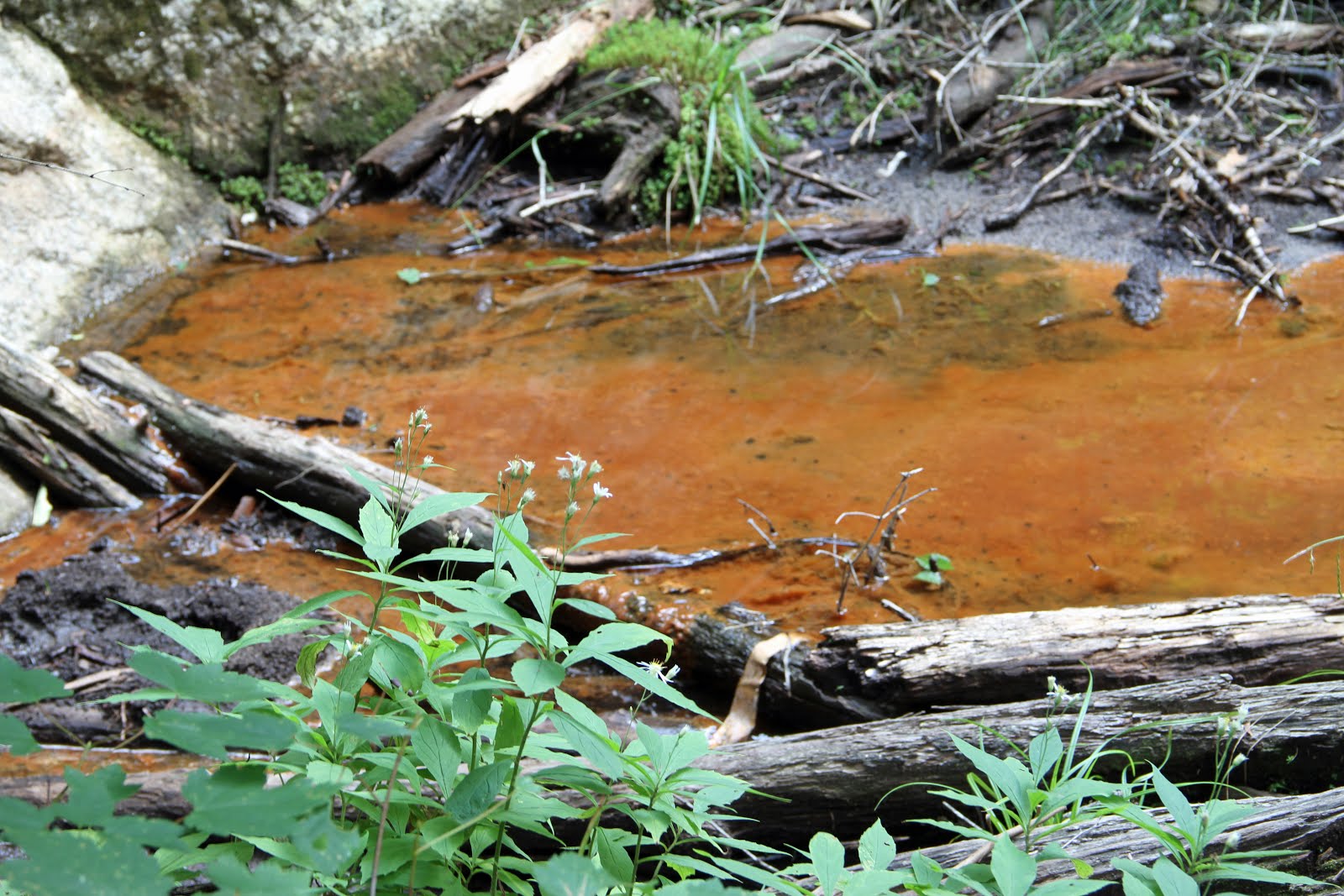
Within the pass is a spruce swamp with boardwalks over the boggy ground which supports the rare fern Dryopteris fragrans. Occasional, rust-colored stagnant pools of water suggest iron-rich pyroxenes that eroded from anorthosite underwent oxidation and imparted a dark-brown, rust color to the water.
AVALANCHE LAKE
Once through the pass you emerge into the uppermost reaches of the Upper Hudson River watershed. You're about to receive a visual reward for your climbing efforts. Before you is spectacular, sparkling Avalanche Lake, the first of three spillover-lakes that lie in a chain within a fault valley. Avalanche Lake is supposedly the highest lake in the United States east of the Rocky Mountains at an elevation of 2,864 feet. I’ll let my industrious readers research that one.
Once through the pass you emerge into the uppermost reaches of the Upper Hudson River watershed. You're about to receive a visual reward for your climbing efforts. Before you is spectacular, sparkling Avalanche Lake, the first of three spillover-lakes that lie in a chain within a fault valley. Avalanche Lake is supposedly the highest lake in the United States east of the Rocky Mountains at an elevation of 2,864 feet. I’ll let my industrious readers research that one.
This is an incredibly special and beautiful place in the High Peaks that evokes strong emotions when first seen. Framed by the precipitous mountain flanks of Colden on the east and Avalanche Mountain on the west, their rock-walls plunge directly into the lake. This view is from the beach looking south from the end of the lake. Barely visible at the far end of the lake is its outlet and an active beaver dam.

Avalanche Mountain’s vertical face plummets a thousand feet into the lake’s western side. Notice the parallel jointing on the rock wall, some of which is curvilinear, composed of metanorthosite and anorthositic gneiss. Alleghenian orogenic collisions of the Paleozoic, most likely the Taconic, are responsible for these deformational features along with the reactivation of faulting that contributed to the formation of the valley. Also notice the pattern of exfoliation in areas of the cliff with a reverse-step pattern. Anorthosite shares this property with granite by eroding from the surface in layers like an onion. Around the lake mixed conifers and deciduous hardwoods luxuriate in remnants of glacial till, a mixture of clay, sand, silt and stone.

The following USGS topographic map illustrates the NE-trending fault-valley that contains the lakes of Avalanche, Colden and Flowed Lands (not seen), all south of Avalanche Pass. The closeness of the contour lines on Avalanche Mountain’s eastern face reflects its thousand-foot verticality. Faults within the Grenville basement served to weaken the bedrock. Following Late Cretaceous uplift and unroofing, the bedrock was more readily eroded and excavated by Pleistocene Continental ice sheets that slowly bulldozed through the region.
The system of spillover lakes is a product of the post-glacial watershed that was established. Surface water elevations are primarily controlled by the underlying bedrock elevation rather than the type of bedrock. As mentioned, a trellis drainage pattern has developed in response to the system of faults and is superimposed upon an outward-from-the-center radial pattern dictated by the Adirondack’s uplifted dome (see my post Part I here).

LAKE COLDEN AND AVALANCHE PASS FROM THE SOUTH
From the trail along the lake's western shore, this two-photo panorama looks back to the north at Avalanche Pass and its defining and confining cliffs of Avalanche Mountain and Mount Colden on the west and east, respectively. The lake is also notorious for its double echo at this spot which we tested successfully.
From the trail along the lake's western shore, this two-photo panorama looks back to the north at Avalanche Pass and its defining and confining cliffs of Avalanche Mountain and Mount Colden on the west and east, respectively. The lake is also notorious for its double echo at this spot which we tested successfully.

This Goggle Earth, northeast-facing, aerial-view of the fault helps to illustrate the orientation of Avalanche Pass and Lake to Avalanche Mountain on the west and Mount Colden on the east. Shear displacement along the fault on the western side is to the southwest. Notice the rock slides that have scarred the slopes of Mount Colden. Also notice the outlet-brook that flows from the lake's south end toward Lake Colden.

“HITCH-UP MATILDA!”
The trail south continues along the west side of the lake, but it’s nothing like you might expect. In two stretches where the cliff plummets straight into the lake the only way to construct a trail in the 1920’s was to bolt two, wooden catwalks to Avalanche Mountain’s rock-face. And that’s not all. Over a dozen wooden boardwalks and ladders lead you up, over and around massive boulders that have torn loose from above and littered the shoreline. It reminded me of the board game Chutes and Ladders from my youth.
The trail south continues along the west side of the lake, but it’s nothing like you might expect. In two stretches where the cliff plummets straight into the lake the only way to construct a trail in the 1920’s was to bolt two, wooden catwalks to Avalanche Mountain’s rock-face. And that’s not all. Over a dozen wooden boardwalks and ladders lead you up, over and around massive boulders that have torn loose from above and littered the shoreline. It reminded me of the board game Chutes and Ladders from my youth.
As the 1868 story goes, a young woman named Matilda was being carried by a guide through the pass. As the water deepened, her sister repeatedly urged Matilda to “Hitch-up!” in order to remain dry. Such is the mountain lore of the Adirondacks.


THE TRAP DIKE OF COLDEN
Another surprise awaits the climber! Halfway down the lake on Hitch-up Matilda, Mount Colden’s famous and infamous “Trap Dike” comes into view across the lake. Dikes are conduits that transport molten, pressurized magma through fractures and weaknesses in the crust. Being less resistant to erosion than the anorthositic country rock through which it intruded, the dike has since weathered out upon its exhumation and exposure, leaving the gaping chasm that we see today.
Another surprise awaits the climber! Halfway down the lake on Hitch-up Matilda, Mount Colden’s famous and infamous “Trap Dike” comes into view across the lake. Dikes are conduits that transport molten, pressurized magma through fractures and weaknesses in the crust. Being less resistant to erosion than the anorthositic country rock through which it intruded, the dike has since weathered out upon its exhumation and exposure, leaving the gaping chasm that we see today.
The dike appears as a deep, 80 foot-wide, vertical gash that extends from the lake to Colden’s summit, a distance of almost 2,800 feet. The dike's immense size is very deceiving with its length being twice the height of the Empire State Building. Look at the massive evergreens for scale.

Although many hikers believe that you become ‘trapped’ once you enter the dike (which has some truth historically), the word is actually Swedish for stairs (trappa) referring to the “steps” that formed in the dike’s magma as it cooled and contracted. Geologically referred to as the Avalanche Dike, it was first explored by pioneering geologist Ebenezer Emmons in 1836 who described the experience of being within its vertical walls as of a "sublime grandeur.” Ebenezer made this sketch of "The Great Trap Dyke at Avalanche Lake" in 1883.

DEFINING THE DIKE GEOLOGICALLY
Compositionally, the Trap Dike is a diabase of garnetiferrous metagabbro. The presence of garnet within the dike is a signature of high grade, granulite-facies metamorphism, and suggests that it intruded before the final metamorphic tectonic event to affect the Central Highlands Region.
Compositionally, the Trap Dike is a diabase of garnetiferrous metagabbro. The presence of garnet within the dike is a signature of high grade, granulite-facies metamorphism, and suggests that it intruded before the final metamorphic tectonic event to affect the Central Highlands Region.
The dike emplaced before anorthosite host-rock crystallization based on such characteristics such as sharp contacts with the anorthosite and its cross-cutting relationship. Its intrusion and metamorphism occurred during the protracted Grenville Orogeny, a billion years before the uplift of the Adirondacks into a mountain range in the Late Cretaceous.
Although the Grenville Orogen was extremely complex, highly protracted and multi-phasic, for purposes of simplicity it can be subdivided into four major events: a subduction arc-collision, an episode of voluminous anorthosite and AMCG intrusion, a strong collisional event and an extensionally-dominated collapse of the orogen. The Trap Dike's gabbroic rock likely would have formed during anorthosite petrogenesis and its intrusion shortly after the host-anorthosite emplaced. For more information on anorthosite evolution, please visit my post Part III here.

A CLUE TO THE REGIONAL LANDFORM
The rock-type on opposite sides of Avalanche Pass is anorthosite, suggesting that the landform might simply have resulted from closely-spaced joints, of which there are many. The formative clue is revealed by Colden's Trap Dike which continues on the opposing side of the valley across the lake. Offset of the two dike-segments on either side confirms the landform is indeed a fault-valley, as is Indian Pass on the west of the MacIntyre Range between it and Wallface.
The rock-type on opposite sides of Avalanche Pass is anorthosite, suggesting that the landform might simply have resulted from closely-spaced joints, of which there are many. The formative clue is revealed by Colden's Trap Dike which continues on the opposing side of the valley across the lake. Offset of the two dike-segments on either side confirms the landform is indeed a fault-valley, as is Indian Pass on the west of the MacIntyre Range between it and Wallface.
ROCK SLIDES OF COLDEN
Also of interest are the bare rock surfaces on Colden’s granite-like face. They are in fact landslide scars and are typical of many high peaks in the Adirondacks. The thin cover of soil that tentatively clings to the anorthosite 's rough surface is stabilized by vegetation but can become destabilized on steep slopes when saturated by heavy, unrelenting rains.
Also of interest are the bare rock surfaces on Colden’s granite-like face. They are in fact landslide scars and are typical of many high peaks in the Adirondacks. The thin cover of soil that tentatively clings to the anorthosite 's rough surface is stabilized by vegetation but can become destabilized on steep slopes when saturated by heavy, unrelenting rains.
The Trap Dike serves as a natural funnel for runoff and slide material by channeling everything down to the lake. At the dike’s outlet a large debris fan extends out into the lake. So massive was the debris-flow from Hurricane Floyd in 1999 that it instantly raised the height of the lake ten feet, and in 2007 an avalanche on Colden blasted debris to the opposite shore. Historically, the earliest documented slides are from the hurricanes of 1869 and 1942.

This view of Colden’s west face was taken from Mount Algonquin on our climb the previous day. Old slides are distinguished from new by the color of freshly exposed plagioclase gleaming in the sunlight. The slides' funneling of material into the dike have deforested its lower half. The dike's vegetated upper portion appears as a depression and continues over the crest of Colden and beyond, as seen on the topo map (above). Remember that the dike continues to the west as well into the body of Avalanche Mountain, offset by faulting regionally. A second, smaller dike also has been found on Colden near its summit parallel to the foliation of the anorthosite.

Aside from its prominence and topographic expression, Mount Colden's dike is not unique in these high peaks of the Adirondacks. For example, a billion years after the emplacement of the Trap Dike, swarms of gabbroic dikes formed during the Mesozoic rifting of the Atlantic Ocean, but they occur with greater abundance in the eastern Adirondacks, southeastern New York and throughout New England.
CLIMBERS BEWARE!
Since the first documented climb in 1850, the Trap Dike has become a classic and dangerous mountaineering route in the High Peaks, renowned for its steepness and difficulty especially in wet weather. It contains many large boulders and ledges to negotiate, and even a waterfall or two in the spring. Wet anorthosite, even with its rough texture, can be extremely slippery when wet.
Since the first documented climb in 1850, the Trap Dike has become a classic and dangerous mountaineering route in the High Peaks, renowned for its steepness and difficulty especially in wet weather. It contains many large boulders and ledges to negotiate, and even a waterfall or two in the spring. Wet anorthosite, even with its rough texture, can be extremely slippery when wet.
Climbers heading for Colden's summit that bail out of the dike too early find themselves on a precipitously-steep, exposed-slope of 45º. “Stay in the dike, where the climbing becomes easier!” warn online climbing journals where the best spot to exit the dike is marked by a cairn. Overall it’s a non-technical, Class 3-4 climb, but many rescues take place when climbers get stuck or "trapped" in the dike, and many have lost their lives by literally falling off the mountain. Check out YouTube.com for climbing videos, but don't forget to look at the geology!
AVALANCHE LAKE TO LAKE COLDEN
Continuing further on the trail, Avalanche Lake’s outlet at its south end provides a close look at a beaver dam and a tremendous view north toward Avalanche Pass. We’re looking directly up the fault!
Continuing further on the trail, Avalanche Lake’s outlet at its south end provides a close look at a beaver dam and a tremendous view north toward Avalanche Pass. We’re looking directly up the fault!

Having departed from Avalanche Lake, we followed its outlet stream down to Lake Colden at an elevation of 2,766 feet. Colden is the second of three lakes in the chain within the fault-valley and the end of our journey into the High Peaks Wilderness. Beyond Lake Colden’s beaver-marsh, we’re looking north toward Colden with its rock slides. The trail continues on below Lake Colden along another outlet brook to the curiously named lake of Flowed Lands which drains south to the Hudson River and down to the Atlantic Ocean.

Lake Colden ended our exploration of the chain of lakes within Avalanche "fault." A curious stream enters the Flowed Lands from the east called Opalescent Brook. The stream bed is renowned for its anorthosite filled with beautiful, blue-green iridescent labradorite that shimmers in the water. We were hoping to reach that point, but the trek got the best of us. The round trip was almost 12 miles and 8 hours, returning via the same route. Perhaps next summer!
"FOREVER WILD"
In spite of the fact that the Adirondack Park and Forest Preserve was established with the catchy phrase “Forever Wild” in 1885, the logging industry managed to denude vast areas that left the region susceptible to wildfires. In 1903 an estimated 600,000 acres of land burned in the Adirondacks including vast tracts of this High Peaks Watershed. Various conflagrations continued for an additional decade. Between rampant logging, forest fires and disruption to wildlife, much of the Adirondack wilderness laid decimated.
In spite of the fact that the Adirondack Park and Forest Preserve was established with the catchy phrase “Forever Wild” in 1885, the logging industry managed to denude vast areas that left the region susceptible to wildfires. In 1903 an estimated 600,000 acres of land burned in the Adirondacks including vast tracts of this High Peaks Watershed. Various conflagrations continued for an additional decade. Between rampant logging, forest fires and disruption to wildlife, much of the Adirondack wilderness laid decimated.

The Adirondack region was the "crucible of the American conservation ethic" at the turn of the twentieth century (The Great Experiment in Conservation by Porter et al, 2009). These days, tourism, timber and mining are the mainstays of the modern Adirondack economy. Yet, significant change is likely to be in the future of the Adirondacks as it continues to grapple with a shared vision of sustainability.
The mountains are actually wilder and more pristine now than they were a century ago. Today, the park's 2.6 million acres are heavily protected and well-managed. Its size is 6 million acres, larger than Yellowstone, Yosemite, Grand Canyon, Great Smoky and Everglades National Park COMBINED!
“We do not inherit the earth from our ancestors;
We borrow it from our children.”
Native American proverb
We borrow it from our children.”
Native American proverb