Every blogger knows the challenge. What shall I blog about next? What photos should I use? By the time the end of the year rolls around, there are always a few posts that never quite made it. And so, with this final post of the year, here they are from here and there.

January
This massive, foot-long clast of Westboro Formation quartzite is embedded within an arkosic sandstone matrix of the Late Proterozoic Roxbury Conglomerate, one of two surficial rock units that comprise the Boston Basin. The Roxbury arrived in (better stated to have participated in the formation of) New England within the terrane of Avalonia, having rifted from the supercontinent of Gondwana in the middle latitudes of the southern hemisphere. Avalonia and its accompanying Roxbury made the tectonic journey across the closing Iapetus and Rheic seas during the Early to Middle Paleozoic. This puddingstone initiated my personal geological journey some twenty years ago.
Brookline, Massachusetts

February
A paper-thin veneer of new ice supports a bevy of gulls.
Chestnut Hill Reservoir, Newton, Massachusetts
A paper-thin veneer of new ice supports a bevy of gulls.
Chestnut Hill Reservoir, Newton, Massachusetts

March
Evidence for changing sea levels exists around the world including the Bahamas.
Low tide has exposed "shore rocks" along the island's north coast which are in reality
150,000 year old fossilized star, starlet and brain coral. This former patch reef was once covered by water considerably deeper during the last interglacial period. During the ensuing glacial period, the sea floor became exposed on land and covered by a limestone-derived soil. The crusty soil is eroding and can be seen on the coral, that is if you can take your eyes off the Caribbean's incredibly blue-green water.
Cable Beach, New Providence Island, Bahamas
Evidence for changing sea levels exists around the world including the Bahamas.
Low tide has exposed "shore rocks" along the island's north coast which are in reality
150,000 year old fossilized star, starlet and brain coral. This former patch reef was once covered by water considerably deeper during the last interglacial period. During the ensuing glacial period, the sea floor became exposed on land and covered by a limestone-derived soil. The crusty soil is eroding and can be seen on the coral, that is if you can take your eyes off the Caribbean's incredibly blue-green water.
Cable Beach, New Providence Island, Bahamas

March
This is a positive (upper member) cast of a portion of a trackway of a bipedal theropod in shallow-water, arkosic sandstones of the Lower Jurassic Portland Formation. This brownstone, the building stone that shaped America during the late 1800's, was deposited in an aborted rift basin called the Hartford Basin in response to the opening of the Atlantic Ocean. The foot-long footprint is likely that of a Dilophosaurus or Coelophysis, early carnivors of the Mesozoic. Not too far from here in South Hadley, Massachusetts, in 1802 a farm boy named Pliny Moody discovered the first trackway in North America. That was in the Deerfield Basin, a failed rift basin almost identical stratigraphically to the Hartford. The local preacher, seeing the print's three-toed anatomy, called it Noah's Raven, a prophetic analysis considering the evolutionary relationship between reptiles and birds.
Meehan Quarry, Hartford Basin of the Connecticut Valley, Portland, Connecticut
This is a positive (upper member) cast of a portion of a trackway of a bipedal theropod in shallow-water, arkosic sandstones of the Lower Jurassic Portland Formation. This brownstone, the building stone that shaped America during the late 1800's, was deposited in an aborted rift basin called the Hartford Basin in response to the opening of the Atlantic Ocean. The foot-long footprint is likely that of a Dilophosaurus or Coelophysis, early carnivors of the Mesozoic. Not too far from here in South Hadley, Massachusetts, in 1802 a farm boy named Pliny Moody discovered the first trackway in North America. That was in the Deerfield Basin, a failed rift basin almost identical stratigraphically to the Hartford. The local preacher, seeing the print's three-toed anatomy, called it Noah's Raven, a prophetic analysis considering the evolutionary relationship between reptiles and birds.
Meehan Quarry, Hartford Basin of the Connecticut Valley, Portland, Connecticut
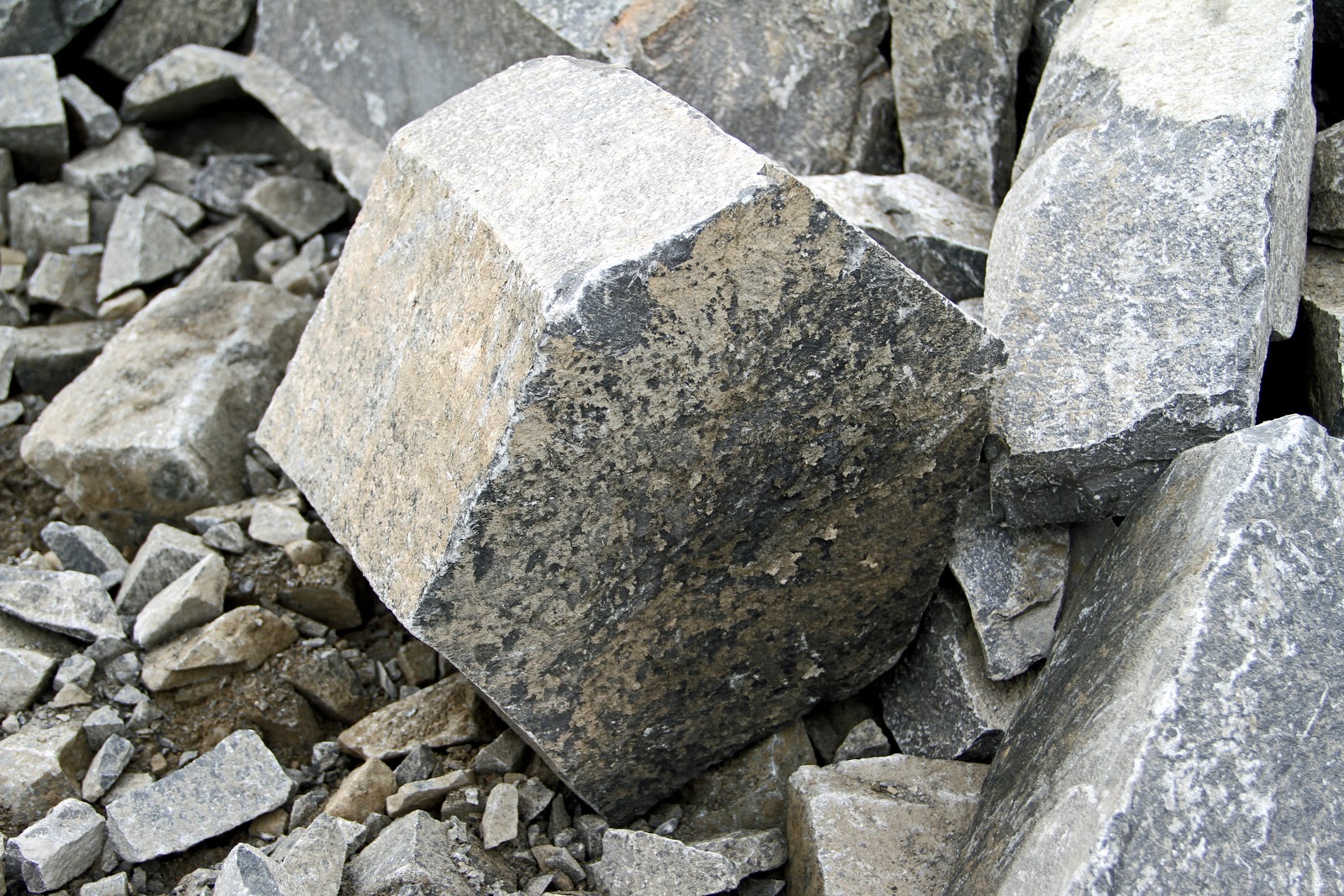
March
This hexagonal tholeiitic basalt, with its characteristic geometry of extremely regular polygonal joints, formed as a consequence of its cooling history. These erratics fractured from a colonade of the Lower Jurassic Holyoke Basalt Flow, the middle of three flood basalts that were generated in 1,200 miles of Mesozoic rift basins along the eastern margin of North America (and across the Atlantic as well) during early rifting of the Atlantic Ocean. This trap rock, as it's called colloquially, has its name derived from the Swedish word for stairs ("trappa") referring to the step-like pattern the extrusive igneous rock assumes once cooled and contracted. Interestingly, the generation of massive volumes of this flood basalt is cited as a possible cause of the Permo-Triassic extinction event.
Tilcon Trap Rock Quarry, North Branford, Connecticut

April
Preserved in the famous Bertie Waterlimes of Central New York, these are exoskeletal molts of Eurypterus remipes, also known as a "sea scorpion," a necessity of growth for all body- and limb-jointed arthropods. Classified as a chelicerate (along with spiders and horseshoe crabs) based on the morphology of its anterior appendages, it was a marine creature actually related to a similarly marine scorpion. Both plied the hypersaline seas that formed cratonward within the foreland basin of the Taconic Orogeny during the Late Silurian. Eurypterids went extinct at the end of the Paleozoic during the end Permian extinction along with up to 96% of marine species. Scorpions survived the Great Dying and now enjoy a terrestrial existence.
Bertie Waterlimes, Lang’s Quarry, Passage Gulf, Ilion, NY

May
I have been jogging around this reservoir for thirty-five years. It was constructed in 1870 to supply the fresh water demands of growing Boston and its environs but is now a haven of tranquility in the heart of the city. I’m continually astounded by the diversity of the wildlife that one finds here: geese, ducks, swans, gulls, hawks, falcons, turkeys, heron, egrets, fox, coyote, raccoons, muskrats, mice, snakes, frogs, fish, and the usual collection of squirrels, rabbits, dogs and humanoids. And it's decorated with fantastic ledges of the Roxbury Conglomerate!
Chestnut Hill Reservoir, Chestnut Hill, Massachusetts

May
...and even turtles.
Chestnut Hill Reservoir, Chestnut Hill, Massachusetts


July
My colleague and I, while traveling through northwestern New Mexico, spotted the stone edifice from a distance. Not intending to stop, we became overwhelmed by its mystical presence and stayed for a day. Unlike our conventional perception of volcanoes that exude lava and build up a conical, vertical structure, Ship Rock emplaced within the Earth's crust phreatomagmatically, gas-charging its magma when it hit the water table. Its maar-crater at the surface and over 3,000 feet of overburden have eroded away in the last 25 million years, give or take. That left the erosion-resistant diatreme as testimony to the fury, topping out at 1,583 feet. The wall-like linear structure off to the left is a radial dike, one of three major feeder-conduits that emanate from Ship Rock.
Ship Rock, San Juan County, New Mexico
Preserved in the famous Bertie Waterlimes of Central New York, these are exoskeletal molts of Eurypterus remipes, also known as a "sea scorpion," a necessity of growth for all body- and limb-jointed arthropods. Classified as a chelicerate (along with spiders and horseshoe crabs) based on the morphology of its anterior appendages, it was a marine creature actually related to a similarly marine scorpion. Both plied the hypersaline seas that formed cratonward within the foreland basin of the Taconic Orogeny during the Late Silurian. Eurypterids went extinct at the end of the Paleozoic during the end Permian extinction along with up to 96% of marine species. Scorpions survived the Great Dying and now enjoy a terrestrial existence.
Bertie Waterlimes, Lang’s Quarry, Passage Gulf, Ilion, NY

May
I have been jogging around this reservoir for thirty-five years. It was constructed in 1870 to supply the fresh water demands of growing Boston and its environs but is now a haven of tranquility in the heart of the city. I’m continually astounded by the diversity of the wildlife that one finds here: geese, ducks, swans, gulls, hawks, falcons, turkeys, heron, egrets, fox, coyote, raccoons, muskrats, mice, snakes, frogs, fish, and the usual collection of squirrels, rabbits, dogs and humanoids. And it's decorated with fantastic ledges of the Roxbury Conglomerate!
Chestnut Hill Reservoir, Chestnut Hill, Massachusetts

May
...and even turtles.
Chestnut Hill Reservoir, Chestnut Hill, Massachusetts

June
It's the world's tallest freestanding stone structure, standing sentinel over our nation's capital since 1884. The Washington Monument is incredibly photogenic. It virtually begs to be photographed. The challenge is to capture it in a uniquely individual way. Architectural geology can be a lot of fun especially if you're familiar with the quarry of origination. The obelisk's exterior is marble from Maryland, Texas and Massachusetts, while its interior backing is composed of sandstone and crystalline rocks (glassy intrusive igneous rocks) from Maryland. The Massachusett quarry is named the Lee Lime in my home state. Its carbonate rocks were part of a coastal shelf along the then, southern seaboard of the supercontinent of Rodinia over a billion years ago. They were subsequently metamorphosed into marble by the collisional events of the Taconic and Acadian orogenies during the Paleozoic. Knowing the geology seems to give greater depth (no pun intended) to any subject.
National Mall, Washington, District of Columbia
It's the world's tallest freestanding stone structure, standing sentinel over our nation's capital since 1884. The Washington Monument is incredibly photogenic. It virtually begs to be photographed. The challenge is to capture it in a uniquely individual way. Architectural geology can be a lot of fun especially if you're familiar with the quarry of origination. The obelisk's exterior is marble from Maryland, Texas and Massachusetts, while its interior backing is composed of sandstone and crystalline rocks (glassy intrusive igneous rocks) from Maryland. The Massachusett quarry is named the Lee Lime in my home state. Its carbonate rocks were part of a coastal shelf along the then, southern seaboard of the supercontinent of Rodinia over a billion years ago. They were subsequently metamorphosed into marble by the collisional events of the Taconic and Acadian orogenies during the Paleozoic. Knowing the geology seems to give greater depth (no pun intended) to any subject.
National Mall, Washington, District of Columbia

My colleague and I, while traveling through northwestern New Mexico, spotted the stone edifice from a distance. Not intending to stop, we became overwhelmed by its mystical presence and stayed for a day. Unlike our conventional perception of volcanoes that exude lava and build up a conical, vertical structure, Ship Rock emplaced within the Earth's crust phreatomagmatically, gas-charging its magma when it hit the water table. Its maar-crater at the surface and over 3,000 feet of overburden have eroded away in the last 25 million years, give or take. That left the erosion-resistant diatreme as testimony to the fury, topping out at 1,583 feet. The wall-like linear structure off to the left is a radial dike, one of three major feeder-conduits that emanate from Ship Rock.
Ship Rock, San Juan County, New Mexico

July
Between the San Juan Mountains on the west and the Sangre de Cristo Range on the east is an eight mile-long, 700 foot-high sand sea where you'd least expect it, in western Colorado. In fact, it's the tallest dune field in North America! Although its shifting sands rejuvenate with the whim of the wind, the erg remains in one place
in a perfect balance of sediment supply (from the only-true-desert-in-Colorado sands of the San Luis Valley), means of transport (wind and water) and accommodation space (embraced within the Sangre de Cristos). Although cast in the shadow of the late day sun, the dark color of the sand is due to quartz and the volcanic rocks of the San Juans.
Wind-driven sand drifts up the windward slopes of the dunes and then cascades down the leeward slopes. The wind will sculpt the dunes until its windward side slopes gently and the leeward side is short and steep. Can you tell the direction of the prevailing wind?
Great Sand Dunes National Park and Preserve, Colorado

July
I couldn't resist one more view.
Great Sand Dunes National Park and Preserve, Colorado

July
Volcanoes to the west in the Thirtynine Mile volcanic field and the Sawatch Range periodically filled the air
with volcanic ash 35 million years ago. Carried by the wind, ash rained down on the region of ancient
Lake Florissant in Colorado, and along with mudflows, preserved a diverse Upper Eocene ecosystem of fish, insects, mammals and plant material. Silica derived from the ash, in a scenario remniscent of Pompeii, and its interaction
with planktonic blooms produced biofilms that retarded organic decomposition. Perhaps most remarkable
to be silicified are the VW-size tree stumps of Sequoia's, members of an ancient redwood forest
that blanketed the lake region. Notice the two, rusted ends of a saw embedded within the "Big Stump,"
a vestige of wanton and destructive fossil collecting in the late 1800's.
Florissant Fossil Beds National Monument, Florissant, Colorado
Volcanoes to the west in the Thirtynine Mile volcanic field and the Sawatch Range periodically filled the air
with volcanic ash 35 million years ago. Carried by the wind, ash rained down on the region of ancient
Lake Florissant in Colorado, and along with mudflows, preserved a diverse Upper Eocene ecosystem of fish, insects, mammals and plant material. Silica derived from the ash, in a scenario remniscent of Pompeii, and its interaction
with planktonic blooms produced biofilms that retarded organic decomposition. Perhaps most remarkable
to be silicified are the VW-size tree stumps of Sequoia's, members of an ancient redwood forest
that blanketed the lake region. Notice the two, rusted ends of a saw embedded within the "Big Stump,"
a vestige of wanton and destructive fossil collecting in the late 1800's.
Florissant Fossil Beds National Monument, Florissant, Colorado

July
This amiable little fellow actually tried to sell me some auto insurance.
Florissant Fossil Beds National Monument, Florissant, Colorado

August
Minutes from Lake Placid in northern New York State, we're viewing the High Peaks Region
across a dry, pro-glacial lakebed drained by an active Holocene stream. Both formed
after the retreat of the Laurentide Continental Ice Sheet at the end of the Pleistocene.
The bedrock throughout the region, unless buried below glacial erratics, till and outwash,
is Middle Proterozoic Grenville metanorthosite, final vestiges of the supercontinent of Rodinia.
North Elba, Adirondack State Park and Reserve, New York State
Minutes from Lake Placid in northern New York State, we're viewing the High Peaks Region
across a dry, pro-glacial lakebed drained by an active Holocene stream. Both formed
after the retreat of the Laurentide Continental Ice Sheet at the end of the Pleistocene.
The bedrock throughout the region, unless buried below glacial erratics, till and outwash,
is Middle Proterozoic Grenville metanorthosite, final vestiges of the supercontinent of Rodinia.
North Elba, Adirondack State Park and Reserve, New York State

September
This over three-inch monster was spinning its web on my patio. Its the largest spider I've seen outside of the zoo. I've found the web-sheathed dens of tarantulas in the Grand Canyon but never any inhabitants. Taken at night, I illuminated the critter with a flash light to try and photograph its web.

August
For the second consecutive year, this brightly-colored, orange-yellow cluster of mushrooms arose from exactly the same location and at precisely the same time of year in my neighbor’s yard. They fruited on the stump of an aging Maple tree following a week of humid, soaking rains. Their scientific name is Omphalotus but are commonly known as the Jack O’Lantern mushroom. Under suitable conditions of day length, heat,
humidity and nutrition, spores in the soil germinate to produce hyphae. When hyphae of the opposite mating type meet (a romantic love affair made in the soil rather than in heaven), a fruitbody is produced, in this case a mushroom. Mushrooms possess the spore-shedding organs of a new generation. The mushroom and its spores is analogous to an apple and its seeds. The hidden mycelium beneath the soil is the "tree" (sort of). Mushrooms are fungi, nature’s morticians in the natural environment, beneficially biodegrading and nutrient-recycling. As we all know, not all of them are edible. These delectable-looking delicacies are deadly poisonous (as in difficulty breathing, drop in blood pressure, irregular heartbeat and respiratory failure). They also exhibit bioluminescence by glowing in the dark. I returned the following day to harvest a few and observe that peculiar property in a dark room, but my neighbor unfortunately excavated his crop before I could. Based on my calculations, next August there’ll be new specimens to collect. Lesson learned? Don't eat mushrooms that glow in the dark, and you never know what’s growing in your neighbor's yard.

November
Back in D.C. again, I couldn't resist one more shot of the Monument illuminated by the setting sun.
National Mall, Washington, District of Columbia

November
This was my very first try at High Dynamic Range (HDR) photography.
Taken at sunrise, the autumnal colors are totally natural.
This pond is in the heart of town next to a parking lot at the back of a shopping center.
Taken at sunrise, the autumnal colors are totally natural.
This pond is in the heart of town next to a parking lot at the back of a shopping center.
Hammond Pond, Chestnut Hill, Massachusetts

December

December
The last snow storm of 2012 was a mild nor'easter in Boston. It gets its name from the direction the wind is coming from. Regardless of the site of origin of the storm, the nor'easter has a low pressure area whose center of rotation is just off the east coast of New England and Atlantic Canada. Its counter-clockwise rotation produces leading winds in the left-forward quadrant onto land from the northeast. That usually translates into heavy snow or rain depending on the time of the year along with high winds, pounding surf and coastal flooding. By the way, "down east" refers to coastal New England and has its origins as a Maine term for sailing down wind to the east. Can you tell which direction is northeast from the accumulation of snow on the trees?
Chestnut Hill, Massachusetts

That's it for 2012. Happy New Year!
Chestnut Hill, Massachusetts

From Doctor Jack (and Franklin the Border Collie)


