Showing posts with label Vishnu Schist. Show all posts

Sunday, June 10, 2012

Memorable Places Here and There on the Colorado Plateau: The Granite Gorge of the Grand Canyon


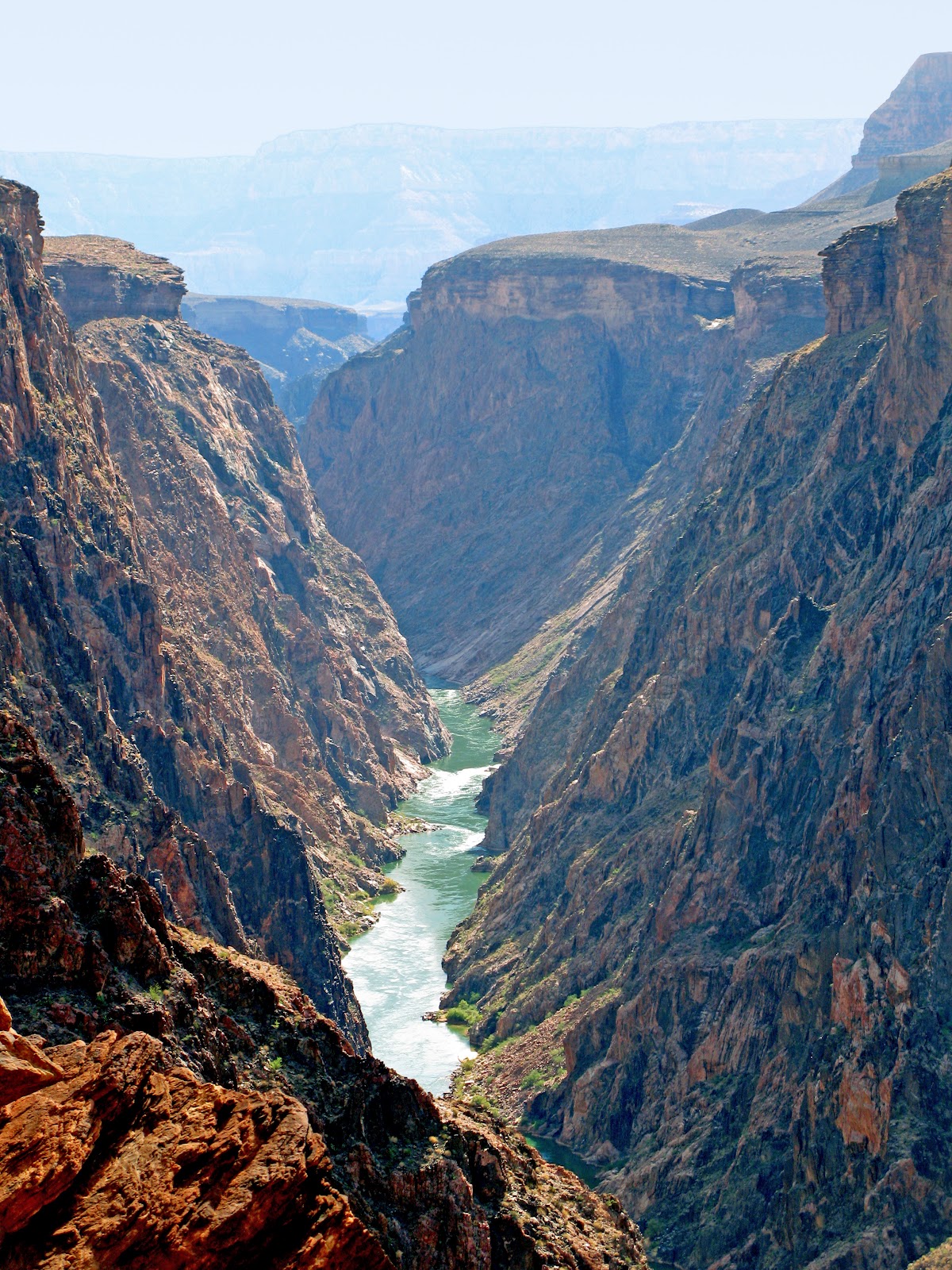
Sometimes one photo says it all.


Clear Creek Trail ascends abruptly from Phantom Ranch at the bottom of the Grand Canyon. The trail guides you through a series of switchbacks and climbs almost a thousand feet before leveling off. As it skirts around rocky corners of the Tonto Platform, it traces the undulating line of the Great Unconformity between the half-billion year old Tapeats Sandstone and the nearly two billion year old Vishnu Schist.

You’re following an enigmatic billion year gap in time along the contour of ancient islands that projected out from the Panthalassic sea. Incredible views of the Colorado River abound as it slices through the Granite Gorge far below.

Eventually, you reach the lofty perch where this photo was taken. You must to sit down. It’s the best seat in the house. All you hear is the warm hum of the wind and the faint murmur of the rapids far below. You never want to leave, and you never will, for it will always be with you.  
  

Friday, February 17, 2012

The Great Unconformity and the Late Proterozoic-Cambrian Time Interval: Part II - The Rifting of Rodinia and the "Snowball Earth" Glaciations That Followed


Some say the world will end in fire,
Some say in ice.
From what I’ve tasted of desire
I hold with those who favor fire.
But if it had to perish twice,
I think I know enough of hate
To say that for destruction ice
Is also great
And would suffice.

Fire and Ice by Robert Frost, 1923

In my previous post on the Great Unconformity of the Grand Canyon, I discussed its contiguous stratigraphy and the regional events involved in their formation. In this follow-up post, in the light of current thought, I wanted to offer a more global interpretation of the events that occurred during its interval.

In the following photo we are peering into the Inner Gorge of the Grand Canyon, as seen from the South Rim. Can you specify the location of the Great Unconformity?  


THE LATE PROTEROZOIC-CAMBRIAN INTERVAL
Our Earth system experienced enormous change during the Late Proterozoic through the Cambrian. This is the time span that encompasses the events that lead up to and include the Great Unconformity. Recorded in the Earth's lithosphere is a history of the unconformity's missing time, of fragmented and lost ancient continents, of a planet frozen solid within a ball of ice, of a global flood of biblical proportions, and an epic tale about the creation, diversification and radiation of radically different new forms of life that appeared suddenly in a biological "Big Bang." It sounds religious, but it's not (although many believe that it is). Its geological, tectonic, climatological and biological. 

Where shall we begin? Let's redefine the Great Unconformity of the Grand Canyon, briefly reprising my previous post. 

THE GREAT UNCONFORMITY OF THE GRAND CANYON
The photo below is taken of the Great Unconformity at arm’s length in a side canyon called Blacktail within the Grand Canyon. All unconformities are gaps-in-time, geological horizons where time and rock layers are forever lost (having been consumed by the forces of erosion) or simply never even formed. The only difference is that this one is massive. It's the mother of all unconformities. It's so important that it's written with capital letters, and that's not all. It's found not only in the Grand Canyon, but all across the globe. But not just anywhere. You have to know where to look. You have to know the geology, and plate tectonics helps. If you know that, you can truly go back in time.

The Great Unconformity resides within the contact between the horizontally-bedded, Early Cambrian Tapeats Sandstone and the vertically-folded, crystalline basement of the Early Proterozoic Vishnu Schist. Notice a conglomeritic lens of Tapeats "trapped" above the contact. Here and there, large chunks of schist and granite have been caught up in the flood that created the shoreline of the Tapeats.

You can almost hear the waves of the gradually rising Panthalassic Ocean (proto-Pacific Ocean) lapping on the shores of a new supercontinent (Laurentia), a remnant of the larger one (Rodinia) that has broken into pieces and whose pieces will one day reunite (Pangaea). One billion two hundred million years, give or take. That's the size of the time gap. That's the amount of time that's unaccounted for within that paper-thin space! A quarter of the Earth's history. Its magnitude is incomprehensible and it's missing!   


MORE QUESTIONS THAN ANSWERS
What events happened during the Great Unconformity? How do we even begin to find out, if the strata holding the clues doesn't exist? Or does it? Why is the end of the Precambrian in the Grand Canyon marked by an unconformity? Why was the interval so long? Is the unconformity found globally? Are any aspects of a Snowball Earth glaciation recorded in the Chuar Group? What is Snowball Earth? What lifeforms, if any, existed during the prolonged interval of the unconformity? How did they survive such a crisis? Did the geological events of the period favor or disfavor their evolution and diversification?  What caused the global high seas following the rifting of Rodinia that flooded the Grand Canyon region and capped the Great Unconformity? Did the rifting of Rodinia somehow influence the climate, glaciation and even the evolution of life?

Let's try to answer these questions. But know that we're treading on thin ice when it comes to a universal consensus regarding many of the issues! The subject of this post is fraught with controversy and riddled with differing opinions and perspectives. Several of the concepts addressed may in time be proven to be completely erroneous, including the concept of Snowball Earth which has its opponents. Many of the issues and hypotheses discussed lack complete agreement amongst earth scientists. That said... 

THE GREAT UNCONFORMITY'S CONTIGUOUS STRATIGRAPHY
Viewed from the South Rim, the billion-year-plus Great Unconformity of the Grand Canyon resides in the contact between the steep, dark, gnarled cliff of Vishnu Schist and the overlying, coarse-bedded, elongate cliffs of the Tapeats Sandstone. Injected under intense heat and pressure well over a billion years ago, prominent dikes of pinkish, pegmatitic Zoroaster Granite can be seen snaking through the schist. Together, they comprise the Granite Gorge Metamorphic Suite and constitute the crystalline basement of the Grand Canyon. The Great Unconformity is sandwiched between these two rock formations. Not quite visible from this perspective, the Colorado River carves the Inner Gorge from the right to the left.


IF THE STRATA DEPOSITED DURING THE INTERVAL OF THE GREAT UNCONFORMITY IS MISSING, THEN HOW DO WE KNOW ANYTHING ABOUT THE EVENTS THAT TRANSPIRED DURING IT?
Buried within the Great Unconformity and distributed in a discontinuous, patchwork-depositional pattern along the Colorado River is a largely fault-controlled sequence of rocks called the Grand Canyon Supergroup. The entire group was deposited during the Middle and Late Proterozoic. Its vertical height at over 12,000 feet is greater than the depth of the Grand Canyon from the rim to the river. Imagine that!

In regions where huge blocks (horsts) of the Supergroup were uplifted by faulting, the Supergroup has virtually eroded away, placing the Early Proterozoic Vishnu Schist in intimate contact with the Cambrian Tapeats Sandstone (as seen in the above photo). And in places where sections of the Supergroup were down-dropped by faulting, it survived erosion, protected if you will, as if buried in a grave (graben). Please visit my previous post for photo examples.
This fortuitous circumstance of geological preservation has provided us with many of the details of what transpired during the Great Unconformity's massive gap of time. By the way, we owe special thanks to the erosive power of the Colorado River system (and lots of mass wasting) to have excavated the Supergroup from its providential burial.


WHERE STRATIGRAPHICALLY IS THE CONTACT THAT ENCOMPASSES THE GREAT UNCONFORMITY?
The red line in the diagram depicts the massive, unconformable contact at the bottom of the Grand Canyon’s Paleozoic column between the Early Cambrian Tapeats Sandstone and the underlying basement structures. Where the Tapeats Sandstone contacts the Early Proterozoic Vishnu Schist (solid blue arrow), resides the Great Unconformity. No intervening deposits of the Grand Canyon Supergroup are preserved. Where the Tapeats  contacts various members of the Middle and Late Proterozoic Grand Canyon Supergroup (dotted blue and dotted green arrows), a “great” unconformity of time exists of perhaps 600 to 700 million years, depending on the specific layer of the Supergroup in contact. Where Bass Limestone, lowermost of the Supergroup, rests on the Vishnu Schist (solid green arrow), a “lesser” unconformity exists of about 200 million years. More time is missing from the stratigraphy of the canyon than is present!


WHEN DID THE EVENTS SURROUNDING THE GREAT UNCONFORMITY OCCUR?
Geology is totally preoccupied with time. Its time is fractally divided into increasingly smaller units of measurement such as eons, eras, periods, epochs, ages, and so on. Geologic time is measured in increments of thousands, millions and billions of years. Anything less is useless. The nomenclature of the time-stratigraphic subdivisions surrounding the Great Unconformity hold some clues to the events that occurred. The timeframe that brackets the unconformity extends from the Early Proterozoic (when the region's crystalline basement was annealed to the core of early Rodinia) through the Middle Cambrian (when rising global seas flooded the margin of the young Laurentian craton). So let's get fractal.

(Modified from the GSA 2009 Geologic Time Scale)

THE PROTEROZOIC EON
The Proterozoic Eon (2500 to 542 Ma) is neatly divided into three eras: the Early (Paleo-), the Middle (Meso-) and Late (Neo-) Proterozoic. The word Proterozoic is derived from the Greek word for "earlier life" in deference to the Phanerozoic of "visible life." During the end of the Proterozoic, life became even more "visible" when it became multi-cellular. That was actually before the Phanerozoic began (and before the Cambrian). 

THE LATE PROTEROZOIC ERA
The Late Proterozoic Era (1000 to 542 Ma) is further subdivided into three periods: the Tonian, Cryogenian and the Ediacaran. These three periods are dated chronometrically, stratigraphically (a work in progress for the Precambrian) and bio-stratigraphically (for the Ediacaran). At first, the periods might seem to have somewhat cryptic names, but their names are actually giveaways regarding the events that happened during them. It's easy to overlook, but the Late Proterozoic was a very long interval of time, comparable in length to the Phanerozoic Eon. As we shall see, the era encompasses an incredibly eventful period in Earth history involving the atmosphere, the oceans, the climate, and life itself.

THE TONIAN PERIOD
The Tonian period (1000 to 850 Ma) derives its name from the Greek word meaning to “stretch” and refers to the extension of the continental plate of Rodinia that led to its eventual breakup. The period begins roughly with the end of the Grenville Orogeny, the final event in the formation of Rodinia. Active rifting of Rodinia began by the mid-Cryogenian. 

THE CRYOGENIAN PERIOD
The name for the Cryogenian period (850 to 630 Ma) is derived from the Greek word for “cold.” The period includes at least two major glaciations: the Sturtian and Marinoan. These glaciations are at the center of a  controversial and hotly debated concept concerning the Earth locked into the icy grip of a frozen "snowball." The Cryogenian period ended with Rodinia actively rifting apart. Given the timing of Rodinia's rifting and the onset of glaciation, might there exist a relationship? 

THE EDIACARAN PERIOD
The Ediacaran (formerly referred to as Vendian, a Eurasian term) period (630 to 542 Ma) is the newest period to be named to the geologic time scale which hasn't had a change (other than date clarifications) in over 120 years. Unlike the cryogenic “icehouse” of the previous period, it was characterized by a warm and humid “greenhouse” climate. This period is known for its large-scale radiation of multicellular life, typified by eponymous metazoans first documented in the Ediacara Hills of the Flinders Range of South Australia but now known to occur at other sites globally. Might there be Ediacaran flora preserved within remnants of the Supergroup, buried within the Great Unconformity of the Grand Canyon? 

THE CAMBRIAN PERIOD
The stratum overlying the Great Unconformity was deposited during the Cambrian Period, the first period of the Paleozoic Era and at the start of the Phanerozoic Eon. The Greek word-root for Phanerozoic means "visible life,"  since it was believed that life first appeared during the Cambrian. That's when life became "macro-scopic", multi-cellular (multicellularity was actually acquired in the latest Proterozoic) and calcified (and well preserved in the fossil record). Complex, highly diversified life in the Cambrian appeared with an "explosion" especially in light of eukaryotes that hadn't evolved extensively beyond a single-cellular (unicellular) stage over a billion years after their first appearance. Is it merely a coincidence that life emerged in the Cambrian following the Ediacara and the glaciations of the Late Proterozoic? Is there a grandiose "scheme" operating here of tectonics, glaciation and genetic emergence? 

WHAT'S ALL THIS HAVE TO DO WITH THE GREAT UNCONFORMITY OF THE GRAND CANYON?
Clearly, lots of things were happening during the unconformity's gap in time both regionally and globally. Let's try to make some sense of it. It hasn't escaped the attention of geologists, sedimentologists, climatologists, paleontologists and geochemists that the events surrounding the Great Unconformity somehow might have come under the influence of Rodinia and its dissociation. As anticipated, Rodinia's fragmentation resulted in a plethora of new landforms: shelves,  shores, continents and oceans, etc. But its break-up involved more than just the creation of new geography. It triggered a radical change in the entire Earth system between the time of its rifting through the deposition of the Cambrian sequences that bracket the Great Unconformity.

Fortunately, for those of us looking into the Grand Canyon for answers, the Grand Canyon Supergroup buried within the Great Unconformity documents the supercontinent’s final formation, its ultimate rifting apart,  indications of widespread glaciations and early vestifes of life. The deposits overlying the Great Unconformity record biblically-remniscent global floods and new lifeforms of the Cambrian explosion that ushered in the Phanerozoic Eon.

WHY IS THE END OF THE PRECAMBRIAN OFTEN MARKED BY AN UNCONFORMITY (AND NOT JUST IN THE GRAND CANYON)?
The supercontinent of Rodinia assembled orogenically between 1300 and 900 Ma. The Grenville Orogen marked its final synthesis, a protracted global-scale, mountain-building, crust-generating event that involved virtually all  continental blocks known to exist at the time. Once fully formed, Rodinia lasted about 150 million years, like the supercontinent of Pangaea that followed. Its assembly left Rodinia standing ‘tall’ and buoyant with new crust that 'floated' in a tectonic ‘sea’ of molten mantle well above that of oceanic crust.

Continental crust has an average density of 2.8g/cm3; whereas, oceanic crust comes in at 2.9-3.0. The difference makes continents 'float' higher than oceans (their ocean basins that is). It’s why ocean basins are filled with water, by floating lower. Floating high, newly formed continents such as Rodinia are subject to erosion. In the case of Rodinia, erosion was prolonged, and as we shall see later, compounded by other events happening at the time that. It is thought (but not by all). 

Why is the Great Unconformity found globally? Massive Rodinia began to break up along its western margin between Laurentia and Australia-East Antarctica, and along its southeastern margin with the Amazonia craton perhaps as early as 750 Ma. Rodinia's rifted, continental siblings possess the signature of the Great Unconformity. Its global presence is attributable to Rodinia rifting apart and sending its eroded, crystalline basement on a worldwide, tectonic journey.

OUTSIDE OF THE GRAND CANYON LET'S LOOK AT THE GREAT UNCONFORMITY OF THE ADIRONDACK LOWLANDS IN NEW YORK STATE
The Great Unconformity is a global entity, not just found within the Grand Canyon or in the Southwest. In my birth state of New York, the Precambrian-Cambrian unconformity is found in the Adirondacks lowlands. Somewhat south of Lake Champlain in the photo, a basal Cambrian Potsdam Sandstone unconformably overlies Middle Proterozoic Grenvillian gneiss. The crystalline basement was generated during the Grenville Orogeny that occurred from one end of Rodinia to the other during the Proterozoic. The Potsdam Sandstone is the geo-equivalent of the Tapeats Sandstone in the Grand Canyon. 

In the photo, thin sandstone bedding of the Potsdam can be seen close to the contact, while its uppermost surface has been heavily eroded, glacially polished and inscribed by glacial striae during the Pleistocene. After Rodinia rifted apart on its eastern shore, the Potsdam was deposited on Laurentia's subsiding shelf bordering the Iapetus Ocean. The region at the time of deposition during the Cambrian was blanketed by a time-trangressive sequence during the Sauk trangression, analagous to the Tonto Group in the Grand Canyon comprising the Tapeats in its basalmost formation. Beginning in the Early Cretaceous and even within the last 20 million years the Adirondacks have experienced a prolonged unroofing history. This has removed the Early Paleozoic sequence from the apex of the Adirondack's slowly rising dome leaving remnants of the Potsdam Sandstone (and the Great Unconformity) scattered about on its periphery. 

Interestingly, the Great Unconformity of the Adirondack lowlands is situated about 150 feet above sea level; whereas, the Great Unconformity of the Grand Canyon lies generally above 3,000 feet. Its low elevation in New York State is related to its relatively stable depositional-locale on the eastern Laurentian shore (in spite of Taconic, Acadian and Alleghenian orogenic events regionally throughout the Paleozoic); whereas, in the Grand Canyon, Cenozoic uplift of the Colorado Plateau has brought the Great Unconformity to its lofty perch, related to Farallon Plate subduction beginning in the latest Jurassic.   


LET'S VISIT THE GREAT UNCONFORMITY OF CAPE TOWN, SOUTH AFRICA
As mentioned, the Great Unconformity is found globally. Wherever a Proterozoic (and in some cases late Archaean) crystalline basement of Rodinia's rifted continents (the two largest of which were Laurentia and Gondwana) were covered by a marine, Cambrian sandstone deposit of the Sauk transgression, the Great Unconformity lurks within the contact.

The Great Unconformity in the photo is located near Cape Town, South Africa. The road is built right on the contact of the unconformity. Note the Jurassic dike running through the granite at bottom center. Jurassic dikes are also found injected into the crystalline basement of New York State related to Pangaean rifting.

This photo and the one below was contributed by Wayne Ranney, geologist, author, lecturer and guide.
Please visit Wayne at http://www.wayneranney.com/ and at his blog http://earthly-musings.blogspot.com/.

AND THE GREAT UNCONFORMITY OF PETRA, JORDAN 
This is the Great Unconformity in Petra, located within the country of Jordan. The region was part of the Arabian-Nubian Shield. Most of its terranes are believed to represent island arcs and micro-continental fragments that accreted to western Gondwana during the Late Proterozoic.


LATE PROTEROZOIC SNOWBALL EARTH
A CHILLING HYPOTHESIS
Through much of its history, our planet has experienced ice ages, from the Archean to the present. In fact, we're currently experiencing modern-day glacial conditions, albeit in the form of an interglacial period, which is estimated to end in 80,000 years or so with the return of continental glacial ice. Glaciations of the Phanerozoic were largely polar events with the exception of three major, mid-latitudinal intervals (for the record during the Ordovician, Carboniferous and Cenozoic).

(Courtesy of SnowballEarth.org)

During the Proterozoic, several glaciations, the first about 2.2 Ba, were thought to have reached well beyond the poles to within 11º of latitude of the equator, while two or more of which (the previously mentioned Sturtian, Minoan and possibly not global Gaskiers) occurred in the Late Proterozoic within 5º of the equator. Following Rodinia's break-up, these glaciations are thought to have been global in their extent and significant in their magnitude. Collectively, they have been colorfully and aptly assigned the catchy phrase "Snowball Earth" in 1992 by Kirschvink (and "Slushball Earth" by Cowen, 2000). In 1998 and 2002 Hoffman and Schrag unified, popularized  and championed the concept known as the Snowball Earth hypothesis.

MOTHER EARTH BECOMES A GLACIAL MIRROR
The hypothesis claims that the Cryogenian glaciations were so severe that global mean temperatures reached from -20º C to -50º C (-75º F) with the oceans frozen to a depth of 1 km in equatorial as well as polar latitudes. That's a weather report very similar to Mars on a nice day! The resulting glaciations produced a "runaway ice-albedo"  feedback (Budyko, 1969), a situation where the sun's radiation would have been reflected back to space by the ice's highly-reflective mirror-like surface. The planet's albedo rises at a faster rate with low-latitudinal ice, because direct sunlight strikes a much larger surface area. The end result is theorized to have created a self-perpetuating "icehouse" scenario.


The consequences of such a severe and prolonged low-latitude glaciation were profound. With the hydrologic cycle and continental weathering shutdown, photosynthetic and biologic productivity would have stalled considerably in the anoxic oceans, but not totally. Surviving within specialized environments called "refrugia" such as hot springs on the sea floor or under the ice itself (where photosynthesis was still possible), life (then represented largely by unicellular protozoa and filamentous bacteria) persisted.

THE RIFTING OF RODINIA AND THE GLACIATIONS OF THE CRYOGENIAN: A TEMPORAL COINCIDENCE OR A  TECTONIC RELATIONSHIP TOO DIFFICULT TO IGNORE?
THE RIFTING OF RODINIA
The supercontinent of Rodinia was assembled through multiple orogenic events between ~1300 and 900 Ma, and persisted, as previously mentioned, for another 150 million years after its assembly. Although the rifting apart of Rodinia might have begun as early as 825 Ma, its break-up on the present-day western and eastern margins occurred initially at ~750 and after ~600 Ma, respectively.

Rifting essentially left Laurentia as the new continental core of proto-North America, flanked by passive margins on its boundaries. The geometric configuration of the continents adjacent to Laurentia's margin on the west currently remains ill-defined resulting in a plethora of proposed paleographic reconstructions (such as Missing-Link and the acronyms AUSWUS, SWEAT and AUSMEX) based on the orientations of Australia and East Antarctica. By 750 to 700 Ma, most of the world's new continents were clustered at low- to moderate-latitudinal positions.


(Modified from Balgord thesis, 2011)

"BABY, IT'S COLD OUTSIDE"
The mid-latitudinal locale of the new continental fragments coincided with the first major global glaciation of the Cryogenian period, the Sturtian (~720 to 660). By ~650 to 630 Ma, the dispersing continental blocks became even further aligned along the paleo-equator. By then, the second widespread, low-latitude glaciation called the Marinoan (~655 to 635) was in full swing. A third glaciation, the Gaskiers, is thought to have occurred at ~580. This period of Cryogenian glaciation is referred to as the Neoproterozoic glacial interval from ~720 to 580 Ma. Note that the precise number (possibly even four or more) and timing of these glaciations remains problematic.

GLACIAL EVIDENCE
The equatorial cluster of continents that occurred over 600 million years ago obviously no longer exists, the continents having tectonically drifted and shifted into their contemporary positions. However, convincing evidence of a snowball state has come from compilations of paleolatitudes and the relics of glacial debris left behind when the ice formed and melted, which are exposed at locations throughout the globe on virtually every continent. Earth scientists have offered variable interpretations for the evidence especially the cap carbonates. 

The geological evidence includes tillites, diamictites, dropstones (marine ice-rafted debris), banded iron formations (BIFs), cap carbonates and glacial markings such as polish and striae. Each deposit tells the story of a particular aspect of glaciation. Geochemical evidence includes depleted carbon 13 isotopic excursion values which indicates a progression from an ocean full of life to one devoid of life during glaciation. Note the arrows in the diagram below showing atmospheric carbon dioxide excursions during the Sturtian and Marinoan glaciations. Also a metalliferous, reducing ocean chemistry resulted from the isolation of the oceans from the atmosphere, which had direct consequences for marine biology in the era immediately after the snowball event.

(Adapted from Bartley and Kah, 2004)


A PLAUSIBLE PLATE TECTONIC-GLACIATION CAUSATION AND THE ROLE OF CARBON DIOXIDE
We've acknowledged the dramatic changes that took place during the Late Proterozoic. Those changes include tectonic, climatic and biologic events. One can't help but ask the obvious question "Is there a coincidence between the rifting of Rodinia and the global glaciations of the Cryogenian Period?" The following is the overwhelming but not sole response to the question.

The global glaciations of the Cryogenian are a reflection of and response to the climatic and geographic variables that existed during the Late Proterozoic. To that extent, a low-latitudinal aggregation of Rodinia’s rifted continents allowed for warmer terrestrial temperatures and higher rates of silicate weathering. Under these conditions atmospheric carbon dioxide concentrations were reduced, thereby decreasing the greenhouse effect and global temperatures. Normally, the climate system would have been stabilized at a new and colder state with global cooling lowering the silicate weathering rate, but two circumstances contributed to a sustained high silicate weathering rate and cooling of the climate.

(From a Lecture by Hoffman and Schrag, 1999)

Rodinia, which began its fragmentation ~830 Ma and continued for 200 million years, produced a multitude of smaller continental fragments that were wetter compared to the arid climate of the former supercontinent's interior. Subsequently, the fragments exhibited increased weathering rates and the deposition of both carbonate and shale with organic carbon along rift basins and margins. A major source of calcium ions and carbonate deposition was provided by the extensive eruption of easily weathered basaltic lava on multiple continents.

The combined effects of tropical continents, supercontinental break-up and extensive eruptions of basalt are thought to have favored cooling, and that led to sea ice at higher latitudes. The growth of ice increased the  albedo which initiated a runaway feedback state. This in turn led to cooler temperatures that expanded the ice equatorially. Voila, Snowball Earth!

ARE THERE OTHER POTENTIAL MECHANISMS CONTRIBUTING TO A SNOWBALL EARTH CONDITION? 
It will come as no surprise that numerous additional models have been suggested as causes for low-latitude glaciations in the Late Proterozoic. Remember, this is a subject riddled with controversy and lack of consensus. Here are just a few. Terrestrial models include a mantle superplume-induced 90º rotation of Rodinia which brought the continent into equatorial latitudes (Li, 2004), a "zipper-rift" hypothesis involving the diachronous rifting of Rodinia (Eyles, 2002), a decreased period of Earth's magnetic intensity (Maruyama, 2008) allowing an increase in cosmic ray-showers which enhances atmospheric cloud formation (Svensmark, 1998) and a subsequent drastic decrease in the surface temperature of the Earth, and plate tectonic causations relating to the rate of seafloor-spreading and maximum continentality (Veuvers, 1990). Extra-terrestrial models include high Earth obliquity (Williams, 1975, 1993), reduced solar luminosity during the Proterozoic, increased cosmic gamma rays from a galactic star burst in the Early and latest Proterozoic, and long-term periodicities in global tectonic phenomena linked to motions of the solar system through the galaxy (Rampino, 1986).

WHAT EVENT(S) TRANSPIRED TO DEFROST THE PLANET?
While the ice continued to advance, the equatorially-situated continents continued to consume atmospheric carbon dixoide as their silicate rocks weathered. By the time the earthly snowball was complete, the atmosphere had little carbon dixoide left to act as a greenhouse gas. So how did Earth escape from its frozen grip?

The Snowball Earth hypothesis further predicts that the planet defrosted when the high albedo of the reflective, ice-covered oceans was overcome by volcanic outgassing of enormous quantities of carbon dioxide into the atmosphere in the absence of sinks for carbon. Normally, this endless supply of carbon is offset by the erosion of silicate rocks. The chemical breakdown of the rocks converts carbon dixoide to bicarbonate which is washed to the oceans.

(Source Reuters)

So, the enormous reservoir of volcanic carbon dioxide "rocketed" (Cowen) the entire planet into an intense greenhouse "hothouse" period from its former "icehouse" condition. The resultant global warming is thought to have violently deglaciated the planet in the short interval of 10 million years. Catastrophic, rapid warming and deluges of acid rain would have immediately precipitated calcium carbonate into the warming seas and created Snowball Earth's signature (albeit enigmatic) juxtaposition of greenhouse "cap" carbonates overlying icehouse glacial sediments. Ultimately, photosynthesis and weathering brought down the carbon dioxide levels, allowing the world to make a biological recovery.

The majority of earth scientists agree on the massivity and timing of the enigmatic Cryogenian glaciations but disagree on aspects such as their globality, the triggers that caused them, the drivers that perpetuated them, and even the conditions necessary to exit the frozen, snowball state. It's conceivable that in regards to icehouse intervals, several proposed circumstances must coincide to initiate a feedback condition favorable for glaciation.

IF THE PLANET MADE A RECOVERY FROM ITS FROZEN GRIP, WHY DID THE CYCLE OF GLACIATION REPEAT ITSELF (POSSIBLY THREE OR MORE TIMES)?
The answer lies in the geographic distribution of the continents, their equatorial distribution that initiated the Snowball Cycle to begin with. We see that a pattern has emerged in that a glacial cycle is initiated by geography and ended by volcanic eruption (Cowen). Thus, the planet would have been 'rescued' only when tectonics would have created a less favorable glaciogenic distribution of the continents, which they eventually drifted into.

WHAT'S TO PREVENT A SNOWBALL EARTH SCENARIO FROM RECURRING IN THE FUTURE?
It seems ironic to be asking such a question, while basking in the warmth of an interglacial period possibly (or probably) accentuated by man's release of greenhouse gases into the atmosphere. The likely (and safest) answer to the question is not for many tens of millions of years, since the contemporary arrangement of the continents is distributed in the middle to upper latitudes where carbon dioxide-absorbing chemical weathering is retarded. When the process of plate tectonics eventually re-assembles the continents equatorially (as it has done in the past and will undoubtedly do in the future), snowball earth conditions may again recur. Perhaps the diminishing luminosity of our aging sun or the fragmentation of the next supercontinent will pull the trigger.   

MORE KNOWLEDGE BEGETS MORE QUESTIONS
Lot's of questions are still unanswered! Does the biota, stratigraphy and geo-chemistry of the Chuar Group within the Grand Canyon (that we know was deposited at low-latitudes when Rodinia was breaking up) preserve a record of snowball glaciation? Who were the survivors of the snowball global crisis? In fact, how did they survive? Did the severity and duration of the glaciations of the Cryogenian have an impact on the course of their evolution and  diversity? Does the great global flood of the early Paleozoic have a Rodinian tectonic connection? Did the Snowball Earth event exert controls on the revolutionary changes in the evolution of life forms during the Cambrian Explosion?

ONE CLOSING THOUGHT
A contemporary quote comes to mind by Lynn S. Fichter, a professor in the Department of Geology and Environmental Science at James Madison University. He said, " Nothing in geology makes sense except in the light of tectonics." Theodosius Dobzhansky, a prominent geneticist and evolutionary biologist now deceased, previously stated, "Nothing in biology makes sense except in the light of evolution." It is clearly evident that the Late Proterozoic was one of the most remarkable periods in the history of the Earth. Its events exemplify the intricate interplay of tectonics, the ever-changing environment and the ever-evolving biosphere.   

I see the necessity for one more post on the events of the Great Unconformity...Part III.

Suggested Reading:
"Assembly, configuration, and break-up history of Rodinia: A synthesis" by Li et al, Precambrian Research, 2007.
"Snowball Earth" by Hoffman and Schrag, Scientific American, January 2000.
http://www.snowballearth.org/  


Sunday, January 15, 2012

The Great Unconformity of the Grand Canyon and the Late Proterozoic-Cambrian Time Interval: Part I - Defining It


“It is time. Touch it. Trail your fingers over a billion years.”
From A River Runs Through It, By Charlotte Grahame-Clark


Wayne Ranney (geologist, author, lecturer and guide) affectionately embraces the Great Unconformity in Blacktail Canyon, a side canyon within the Grand Canyon. Horizontally-bedded, basal-conglomeritic, Early Cambrian Tapeats Sandstone is resting directly upon vertically-foliated Early Proterozoic Vishnu Schist. You can visit Wayne at WayneRanney.com.

A TEMPORAL STRATIGRAPHIC GAP = MISSING TIME
Geology is totally preoccupied with time. Time’s passage is recorded by the presence of rock units, but not every geological event is preserved in stone. The absence of a record is of equal importance. Missing time results from rock units that have either eroded away or from periods of time in which no sediment was deposited. Such a gap in the temporal record is called an unconformity, and it's the geologist's business (and passion) to decipher what happened during it.

The global rock record contains countless unconformities, most of which are comparatively minor. There are fourteen major unconformities exposed within the Grand Canyon and unenumerable minor ones. In fact, the Canyon’s rock layers are so full of temporal stratigraphic gaps that far more time is absent than is represented. In Annals of the Former World, John McPhee states, “If a gap of five hundred million years were the right five hundred million years, it could erase the Grand Canyon.”

THE GREAT UNCONFORMITY OF THE GRAND CANYON
Near the bottom of the Grand Canyon, a sandstone formation from the Cambrian called the Tapeats rests upon metamorphosed schist from the Precambrian called the Vishnu. Mysteriously, the rock layers that once existed between the two formations are missing. Perhaps they never even formed. Regardless of the cause, the space of that paper-thin contact represents an enormous amount of time unaccounted for, far greater than all the others, on the order of a billion years. That’s a quarter of the age of the Earth. Missing!

The immensity of this particular time gap has been recognized by geologists that have singled it out as the Great Unconformity written with capital letters. John Wesley Powell, the intrepid explorer, scientist and geologist of the American Southwest, first recognized the time gap in 1869, but failed to appreciate its enormity. The Great Unconformity is not just found within the Grand Canyon but occurs in various locations within the Southwest. In fact, it can be found where ancient Laurentia's Cambrian shelf is exposed and even globally where continental shores received deposition during the Cambrian. Back in New York State where I'm from, we have a Great Unconformity in the Adirondack lowlands in which the Middle Cambrian Potsdam Sandstone overlies a Middle Proterozoic Grenville gneissic-basement on Laurentia’s eastern shore.

PHOTO BELOW: THE GREAT UNCONFORMITY
This spectacular view of the Grand Canyon is from Hopi Point on the canyon’s South Rim. That’s the Colorado River heading west carving a narrow gorge through the resistant, dark Vishnu Schist. Directly above, the Tapeats Sandstone forms a prominent cliff with the missing time of the Great Unconformity sandwiched in the contact between the two rock layers. The Tapeats and the draping-slope above it form the Tonto Platform, an expansive, broad bench and important landform within the Grand Canyon.


LOTS OF QUESTIONS
You can run your fingers from from the Vishnu Schist to the Tapeats Sandstone and literally touch the gap of lost time within the Great Unconformity. Where did over a billion years of time go? How can we attempt to comprehend its magnitude? Where did all the missing rock layers go? How were they removed? Were they ever there to begin with? What event or events caused this massive time-gap to form? Why did it happen at the end of the Precambrian? What happened during it? How do we know? Are the events global in their extent? Will it happen again? There are many questions. Let's attempt to unravel some of the mysteries of the Great Unconformity. But, before we review its contiguous stratigraphy, let's establish a few important definitions.   

UNCONFORMITIES COME IN THREE FLAVORS
If successive rock layers that are deposited without interruption (think of an unbroken depositional sequence) are said to be conformable, then a break in stratigraphic continuity (think of deposition with interruptions) is called an unconformity. There are three types of unconformities, all of which possess a gap in the rock record and all of which are observable within the Grand Canyon.

A disconformity occurs when sedimentary rock layers are deposited, but erosion of the older, underlying layer has occurred. If after deposition, tectonic movement (such as during mountain formation) of the layers creates uplift, tilting and erosion, and then younger layers are deposited over the older, tilted rocks, an angular unconformity is formed. A gap in the record exists between the younger, horizontal package and the tilted, older package, which has a contact that is easier to recognize due to the non-parallel rock layers. Angular unconformities generally indicate a longer time hiatus than do disconformities, because the underlying rock is generally metamorphosed, uplifted and eroded before the overlying rock has been deposited. A nonconformity occurs when overlying sedimentary rocks are deposited directly over igneous or metamorphic rocks. As we shall see, the Great Unconformity is classified as a nonconformity.

The red lines in the diagrams below represent the contacts of the three types of unconformities: an angular unconformity, a nonconformity and a disconformity.

(Modified from Earth and Atmospheric Sciences, University of Alberta’s website)

 
A VERY ABBREVIATED GEOLOGICAL BIG PICTURE OF THE GRAND CANYON REGION
Under what geological circumstances did the rock layers above and below the Great Unconformity form? Let’s briefly investigate the geological events from the Early Proterozoic through the Cambrian in the region of the Grand Canyon. Of course there’s an even earlier story and a later story, geology never rests, but it's not germane to our immediate discussion.

I - LAYING DOWN THE BASEMENT OF THE GRAND CANYON
During the Early Proterozoic Era from about 1,600 to 1,700 million years ago, a cluster of oceanic island-arcs (first the Mojave, then the Yavapai, and finally the Mazatzal) collided with the growing supercontinent of Rodinia. Their accretion formed a dramatic, coastal mountain range as new crust was incrementally annealed to ancestral North America's growing southwest margin (western by a Cambrian global perspective) including the region of the future Colorado Plateau and Grand Canyon.

The following imaginative paleographic map by Ron Blakey, using tectonic scenarios that resemble the southwestern Pacific Ocean as a modern analogue, illustrates how Proterozoic crust in the Southwest may have been created. The red dot depicts the region of the contemporary Grand Canyon.


Early Proterozoic arcs drifting toward their inevitable subduction zones on Rodinia's southwest margin
(Modified from Ron Blakey, Colorado Plateau Geosystems, Inc)


This map of the contemporary Southwest depicts the Proterozoic crustal provinces that formed from the incremental amalgamations of the Mojave, Yavapai and Mazatzal arc-terranes to Rodinia's Wyoming Province, its ancestral cratonic core. 


(From Dr. Mike Williams, from http://www.geo.umass.edu/)

 
Heat and pressure of the collisions metamorphosed the intervening mass of lava, ash, sandstone and mudstone into schist, gneiss and amphibolite at depths of 20-25 km. The resultant gnarled, foliated, Silly Putty-like, black rock unit is known as the Vishnu Schist (along with neighboring Brahma and Rama Schists), while the subterranean magmatic chambers and conduits (the plutons and dikes) that fed the fury formed the pinkish Zoroaster Granite (or Zoroaster Plutonic Complex).

The entire igneous and metamorphic package is formally known by geologists as the Granite Gorge (or Grand Canyon) Metamorphic Suite, but is commonly referred to as “Precambrian crystalline rocks”. These basement rocks form the foundation for much of southwestern North America including the Colorado Plateau and the Grand Canyon in particular. All the sedimentary sequences that follow are deposited on this groundwork.

PHOTO BELOW: THE GRANITE GORGE METAMORPHIC SUITE
Draped by greenish Bright Angel Shale, the horizontally-bedded Tapeats Sandstone forms a prominent cliff directly above the dark, foliated Vishnu Schist. The Great Unconformity resides in the contact between the two rock units. Notice the wavy, pinkish-dikes of Zoroaster Granite intruded into the dark Vishnu Schist. These rocks comprise the Granite Gorge Metamorphic Suite. The erosion-resistant, crystalline walls of the schist have confined the Colorado River to a narrow, swift channel called the Inner Gorge.


PHOTO BELOW: THE VISHNU SCHIST OF CLEAR CREEK
The meta-sedimentary Vishnu Schist of the side canyon of Clear Creek is so extensively metamorphosed that it is gneissic in appearance displaying marked foliation and boudinage. Sections are so heavily infiltrated by Zoroaster Granite that the schist has a pink marbled appearance.

Also notice the river-polish on the canyon's walls and the "clean look" of the canyon's bed. Heavy rains in the watershed upstream send a torrent of water through the side canyon. Over the millenia, the flood's burden of rocks have scoured the walls to a smooth sheen. Amazingly, the side canyon enters the mainstream Colorado River at grade having excavated down to river level. And as the flood subsides, it sends its rocky load into the main river channel leaving the side canyon's floor "clean" save a few cobbles here and there as the diminishing current looses its capacity to carry rock. The hydrological dynamics of the Grand Canyon's river system is truly fascinating!


PHOTO BELOW: THE ZOROASTER GRANITE
This extreme close up is of the truly spectacular Zoroaster Granite. It is classified as a coarse-grained pegmatite comprised of quartz, alkali-feldspar, mica and hornblende. It formed by partial melting of the lower crust during its deformation over a billion years ago. The Precambrian Vishnu Schist and Zoroaster Granite are considered to be the basement structures or foundation upon which the overlying strata of the Grand Canyon are built. 


II – A VERY SUPER GROUP
By the Middle Proterozoic, the growing landmass of Rodinia had increased in size while the upper crust of the lofty mountains that formed from the collision of the island-arcs had eroded about 10 km to a broad, low-relief plain at sea level. Concomitantly, mid-crustal rocks were buoyantly exhumed (~1,300 to ~1,255 Ma) bringing the metamorphosed schist to the Earth’s surface. The metamorphosed, eroded and exposed cores of the mountains would eventually be overlain by the deposition of the Grand Canyon Supergroup during the Middle and Late Proterozoic. These events are integrally related to the development of the Great Unconformity.

THE ENORMITY OF THE SUPERGROUP
In 1869, John Wesley Powell recognized younger Precambrian rocks than the Vishnu and Zoroaster within the Grand Canyon as “Algonkian” in age and called them the Grand Canyon Series. Today, the Supergroup is comprised of an assemblage of nine different formations that have been combined into two large groups of formations, the Unkar and Chuar, and two interposed deposits, the Nankoweap and Sixtymile Formations.

The Supergroup is exposed in the eastern Grand Canyon and rests with angular unconformity on the Granite Gorge Metamorphic Suite, our basement Vishnu-Zoroaster complex. Taken as a whole, at over 12,000 feet in height, the Supergroup is over twice the height of the Grand Canyon from the rim to the river, and yet is buried beneath it! As we shall see, the Supergroup was later broken by faults, tilted into blocks and planed off by erosion.

The Grand Canyon Supergroup: the Unkar Group, Nankoweap Formation, Chuar Group and Sixtymile Formation. The Grand Canyon Metamorphic Suite underlies the Supergroup; the Tonto Group overlies it.
(Modified from unknown source from a GSA Bulletin)

WHERE IS THE SUPERGROUP FOUND IN THE GRAND CANYON?
The Supergroup, as a whole, is exposed as isolated, fault-bounded remnants along the main stem of the Colorado River within the Grand Canyon. Unlike the Unkar (yellow) which is exposed at several locations along the river, the Chuar Group (orange) is exposed only at one location. In the region of the Butte Fault, the western down-dropped section preserved the Unkar Group (placing the Dox Formation at river level) and the Chuar Group, deposited in the growing “sag” of the Chuar Syncline. Also note the Granite Gorge Metamorphic Suite (Vishnu and Zoroaster) exposed by the Colorado River (blue).

(From Bloch, Crossey, Karlstrom and Timmons, Modified from Timmons, 2004)


III – GRENVILLE OROGENESIS AND THE FINAL FORMATION OF RODINIA 
THE UNKAR GROUP
During the Middle Proterozoic from about 1,255 to 1,100 million years ago, the largely-mudrock of the Unkar Group (red arrow) is thought to have been deposited intracratonically in an environment of extensional tectonism and sedimentation. Its deposition was in tectonic response to plate-margin deformation and crustal shortening during the Grenville Orogen (yellow). The Grenville was the final, protracted mountain-building and crust-forming event in the formation of Rodinia. Deposits within the Grenville Province are found worldwide (yellow).

(Modified from Karlstrom)


IV – THE RIFTING APART OF RODINIA
THE CHUAR GROUP
During the Late Proterozoic from about 1,000 to 740 million years ago, the Chuar Group and brecciated rubble of the overlying Sixtymile Formation were deposited in a synclinal, marine cratonic basin directly west of and during extension on the north-trending Butte fault system. The deposits are inferred to record rifting during the breakup of Rodinia at the dawn of the Phanerozoic Eon. In Blakey's map below, the Chuar Group was deposited in a shallow, marine basin, an arm of the sea that was periodically flooded by seawater.

A recreation of a Late Proterozoic extensional basin in association with Rodinian rifting
(Modified from Ron Blakey, Colorado Plateau Geosystems, Inc)


V - HORSTS AND GRABENS DICE UP THE SUPERGROUP
Rodinia began its inevitable breakup during the Late Proterozoic (~750 Ma) with the newly-forming continents of Western Australia and Eastern Antarctica pulling away from the west (see Karlstrom map above). Normal faulting left the Supergroup with a horst and graben (German words for “thicket” and “grave”) landscape of uplifted mountain ranges and down-dropped, tilted basins, offsetting adjacent blocks of crust almost two vertical miles. Portions of the Basin and Range Province of the Southwest today might be considered an analogous modern landform derived from extensional tectonics.

Ironically, the sedimentary layers of the Supergroup, originally flat-lying and possibly extending tens if not hundreds of miles, that became either uplifted, downdropped and tilted, would end up in a patchy, discontinuous distribution by the beveling of erosion, but only after the forces of the Colorado River exposed it all, over half a billion years later!

Rifting also affected the Grand Canyon region as movement along extensional faults tilted the rocks of the Grand Canyon Supergroup. The primary deformation that tilted the Supergroup strata is thought to have occurred before deposition of the upper Nankoweap Formation (~900 Ma) and the Chuar Group. Extensional deformation recorded in the Chuar Group is thought (Timmons, Karlstrom, GSA Bulletin, 2005) to be related to the incipient rifting of Laurentia, 200 million years after Unkar deposition and tilting.


VI – EROSION AND PRESERVATION OF THE SUPERGROUP
The towering, fault-uplifted horst ranges of the Supergroup were relentlessly attacked and lowered by erosion, completely removing the Supergroup to the extent that the Vishnu Schist and Zoroaster Granite became re-exposed. In places where extensional faulting had down-dropped the crust into rift-valleys, the Supergroup was buried and preserved (as if protected in its grave), forming the surface of the landscape. By the dawn of the Paleozoic, the landscape was nearly flat once again with the exception of a few hills and islands of Vishnu Schist and down-dropped remnants of the Supergroup that survived erosion. Erosion and preservation had taken its toll on the Supergroup.

PHOTO BELOW: THE CREMATION GRABEN JUST NORTH OF THE RIVER
About 750 million years ago during the breakup of Rodinia, a series of extensional faults lowered (white arrows show the displacement) a block of the Unkar Group known as the Cremation Graben into its “grave”. As erosion beveled the landscape and erased all traces of uplifted blocks of the Supergroup, this down-dropped block survived the ravages of erosion long enough to be blanketed by the Tapeats Sandstone during the Cambrian, but not entirely. An island of sparkling pink Shinumo Quartzite (a formation within the upper Unkar Group) projected out of the Cambrian sea out of depositional reach of the Tapeats. We’re truly viewing an ancient landscape!

In the photo below, can you identify the Cremation Graben and its Shinumo island? Can you locate the Cremation Fault between the graben and the Vishnu Schist, the schism in the crust along which the block of Unkar Group deposits faulted downward? Are you able to differentiate the stratigraphic layers of the Unkar Group visible here: the basal Bass Limestone, the reddish slope of Hakatai Shale and the uppermost cliff of resistant Shinumo Quartzite? Lastly, can you find the Great Unconformity (between the Tapeats Sandstone and the Vishnu Schist) and the “lesser” unconformity (between the Tapeats and the Shinumo Quartzite)? 


Here’s the same photo with guide-lines added for identification. Notice the Great Unconformity (upper right) between the overlying Tapeats Sandstone and the Granite Gorge Metamorphic Suite and a “lesser” unconformity (upper center) between the Tapeats and the underlying Shinumo Quartzite. The Cremation Fault runs obliquely to the line of sight in the photo.

(Thanks for the help interpreting this one, Wayne)

 
PHOTO BELOW: THE CREMATION GRABEN JUST SOUTH OF THE RIVER
The Cremation Graben is bounded by the Cremation Fault on its northeast and by the Tipoff Fault on the southwest. The graben has actually been sliced in two by the Colorado River. The southern block in the photo below is seen from high up on the Clear Creek Trail looking south from across the river. That’s the South Kaibab Trail (left) switchbacking its way down the Cremation Fault, through the orangish Hakatai Shale (upper left) and skirting to the left of a cliff of Bass Limestone. Here, the rocks of the Supergroup were eroded to a great extent before the Tapeats was laid down. The fault has offset the Bass which is lying above the Vishnu Schist. Further to the right (center top) a second normal fault also offsets this portion of the lower block of Unkar deposits. Notice the incredible extent that the pinkish Zoroaster Granite has injected throughout the black Vishnu Schist giving it a marbled appearance. 

The tectonic situation here is analogous to the normal faults seen on the east coast of North America in response to Pangaean rifting during the Late Triassic and Early Jurassic that ultimately generated the Atlantic Ocean, only here the faults bear witness to the breakup of Rodinia. The Rodinian breakup on its western shore created the continents of Australia and Antarctica, while the Pangaean breakup on its eastern shore created Europe, Africa and South America.


PHOTO BELOW: THE “CARBON CAMP” BUTTE
We're looking south from Carbon Camp (64.7 river mile) at the entrance to Lava Canyon on the north shore of the Colorado River within the Grand Canyon. The tall, angular butte across the river is formed by upper Unkar Group deposits capped by the Tapeats Sandstone (above the white line). The lavas of the Cardenas (directly below the white line), the uppermost Unkar Group deposit, was emplaced in response to regional crustal extension as a tectonic by-product of the continent to continent Grenville collision on Rodinia’s eastern and southern coasts. The white line also represents the contact of a very large unconformity of perhaps 200 million years. Below the Cardenas lies the Dox Sandstone, near the base of the butte to the right with the rest of the Unkar graben buried in its grave below level.

This down-dropped block of the Unkar Group, having accordingly survived erosion, was uplifted along the Butte Fault which raised land to the west over 1,400 feet. When the lavas erupted, they were near the Dox shoreline, and the Tapeats sediments that followed (much later) were deposited on top of the lavas. About 2.5 miles upstream the Tapeats was at river level. Its lofty perch on the Cardenas seen here will be brought back to river level in about 50 miles downstream.


VII - RISING SEAS
The mountains that formed during the suturing of the terranes to Rodinia's southeast continental margin have long eroded away, as well as the uplifted ranges of the Supergroup. The geological stage was set for fluctuating high seas to gradually inundate coastal and cratonic low-lying regions not just regionally but globally. Over 5,000 miles of Laurentia's miogeocline that formed after Rodinia rifted apart in the Late Proterozoic flooded during the Cambrian.

That worldwide, high-water event is known as the Sauk transgression, one of six during the Phanerozoic. Beach sands of the Tapeats were about to be deposited on the buried remnants of the ancient mountains by the encroaching Cambrian sea in the region of the future Grand Canyon. 

Cambrian high seas flood Laurentia's subsiding miogeocline 
(Modified from Ron Blakey, Colorado Plateau Geosystems, Inc)


VII – THE TONTO GROUP
Scotese’s Middle Cambrian paleomap shows Rodinia’s rifted continental siblings having tectonically dispersed across the globe. The two largest are Gondwana, largely South Polar in location, and Laurentia, located equatorially. Laurentia is rotated 90° clockwise compared to its contemporary orientation. The Grand Canyon region (red dot) was inundated by Panthalassic high seas which flooded low-lying regions of all the continents. The Tonto Group was deposited in the region of the Grand Canyon during this interval. It was also the time of a seemingly-abrupt “explosion” of marine life in the global seas. Only 75 million years earlier, a relatively short period of time geologically, life in the seas was largely unicellular.

(Modified from Scotese.com, 2002)


As the Panthalassic Sea rose, it gradually encroached upon the land. Coarse sandy
beaches and offshore sands of the Tapeats Sandstone were the first of the Tonto Group’s tripartite members to be deposited in shallow waters. In deeper waters, finer clastics of marine muds of the Bright Angel Shale followed, and in still deeper waters, calcitic deposits of the Muav Limestone. All the deposits of the Tonto Group are in gradational and conformable contact. 

As the sea continued to rise and flood the land progressively eastward, the locations where sand, mud and carbonates accumulated shifted with it, forming the world renowned, time-transgressive sequences of the Tonto Group. Beginning with the Tonto Group, the remaining rock formations from the Tapeats to the rim-rocks are the products of the assembly of Pangaea, including its rotation, collision and re-assembly with Rodinia’s continental remnants.
(Modified from Nations and Stump, 1981)

VIII – LOTS OF MISSING TIME
The Tapeats Sandstone came to be the Grand Canyon’s oldest and deepest Paleozoic layer resting upon the Grand Canyon’s Precambrian basement rocks. Where the Supergoup had been completely removed by erosion, the Great Unconformity formed above the Vishnu Schist. Where down-dropped sections of the Supergroup was preserved, a large unconformity developed, the size of which is contingent on what section of the Supergroup had been preserved. For example, where down-dropped sections of the Unkar Group was preserved, its base rests on the rocks of the Grand Canyon Metamorphic Suite creating a major unconformity of about 475 million years while its top has a hiatus approaching 600 million years. Where the top of the Chuar Group is juxtaposed to the Tapeats, a mere 200 million year time gap exists. 

Many geologists have employed the use of comparative terms such as "lesser", "great" and "greatest" to describe the relative size of the gaps in time in association with the Precambrian basement rocks. But in the lexicon of geology there exists only one Great Unconformity, a time gap in which the others don't even come close.


PHOTO BELOW: THE GREAT UNCONFORMITY AND ZOROASTER INCLUSIONS
We are viewing the Great Unconformity at arm’s length within Blacktail Canyon. Blacktail is a popular locale for literally touching the Great Unconformity in the serene setting of a beautiful side canyon. The regional westard dip in the strata has caused the Tapeats Sandstone to descend back down to river level making the details of the Great Unconformity well exposed to view along the river-polished walls of the canyon. In addition, Blacktail Canyon has a great little echo, and if you're really quiet, you can still hear the waves of the advancing Cambrian sea crashing onto the shore as it churns up loose chunks of granite and schist.

According to the geological Principle of Inclusions, clasts are older than the rock in which they are contained. Notice the “loose” fragments of Zoroaster pegmatite from the underlying Grand Canyon Metamorphic Suite incorporated within the contact below the basal-most Tapeats Sandstone. Inclusions can often be utilized to recognize a nonconformity such as this.


PHOTO BELOW: THE GREAT UNCONFORMITY AND VISHNU INCLUSIONS
This view of the contact is nearby the above one in Blacktail Canyon only with Vishnu clasts embedded completely within the matrix of the Tapeats. The transgressing Cambrian sea laid down the Tapeats over this loose Vishnu rubble and incorporated it into beach sand that eventually lithified. The Great Unconformity is a few feet below.


PHOTO BELOW: THE GREAT UNCONFORMITY WITHIN THE GRANITE GORGE
This strikingly beautiful beach within the Upper Granite Gorge along the river is littered with erratics of black Vishnu Schist and pink Zoroaster Granite. Notice the pegmatite dikes emplaced into the Vishnu matrix in the massive block along the river's edge. The Great Unconformity is directly below the Tapeats on both sides of the river.


PHOTO BELOW: PLATEAU POINT AND THE CHEOPS PYRAMID
That's me standing on the edge of time on Plateau Point at sunset, located at the end of a promontory on the broad terrace of the Tonto Platform. Five more feet and it's a 1,320 foot free-fall into the Colorado River at the bottom of the gorge. The Point is an easy stroll from Indian Garden, a camping oasis of cottonwood trees 3,120 feet below the canyon's South Rim. The gently undulating bedrock beneath my feet is the Tapeats Sandstone, and under that is the Great Unconformity juxtaposed above the Vishnu Schist.

Across the gorge is some incredibly beautiful and equally complex geology. My gaze is at the Cheops Pyramid. It's another erosion-surviving, down-dropped block of the Unkar Group. One would assume that's the Tapeats Sandstone at the same level across the gorge (barely visible center right), but it's actually the Bass Limestone, the lowermost Unkar unit. Above it is the shaddowed-slope of orange-red Unkar's Hakatai Shale with a prominent cliff of resistant Shinumo Quartzite higher up. This particular unit of Shinumo was an offshore island in the Cambrian sea. The sloping Bright Angel Shale and the cliffed Muav Limestone crown the pyramid, only without the basal Tapeats since it undoubtedly projected too high above the sea to receive Tapeats deposition but high enough to receive the rest of the Tonto Group. The key to interpreting the stratigraphy is to not so much look at one layer but the relationships between the layers. Of course, a bedrock map will serve as a confirmation. 

So where is the Great Unconformity? It's a trick question. In the photo, it's only on our side of the river between the Tapeats and the Vishnu Schist where an uplifted block of the Unkar Group was removed by erosion. On the far side of the river we have a "lesser" unconformity (of perhaps 600 million years) between the Shinumo Quartzite and the Bright Angel Shale.

Photo (and stratigraphic assistance) courtesy of Wayne Ranney

LAST PHOTO: THE ANGULAR UNCONFORMITY AT APOLLO'S TEMPLE 
Perhaps the most photographed angular unconformity appearing in geology textbooks is the one seen from Desert Tower situated on the eastern South Rim of the Grand Canyon. That's the North Rim in the distance (about 9 miles away), and below it lies the Paleozoic sedimentary column from the Kaibab Limestone down to the Tapeats Sandstone. In front is the sprawling, camouflaged butte of Apollo's Temple (center), held up by a large block of the Unkar Group that runs from the base of the Tapeats (white line) to the river in the foreground (not seen).

Notice the obvious tilt of the entire Unkar Group relative to the horizontality of the Tapeats creating an angular unconformity with the base of the Tapeats. The banded shales and sandstones of the Nankoweap Formation overly the basalts of the Cardenas Lava, and the orange-red Dox Sandstone slopes to the river. Where each of these formations contacts the white line of the Tapeats is a "great" angular unconformity with varying time gaps ranging from about 600-700 million years. 

My white line depicting the "great" unconformity at the base of the Tapeats continues off the photo to the right. Beneath the Tapeats here lies the beginning of a lower portion of the Chuar Group deposited in a syncline just to the west of the Butte Fault.

What tectonic event is responsible for the tilting of the Supergroup before the Tapeats was deposited? Of course, it's the rifting of Rodinia.


(Thank you marlimiller.com)

MORE QUESTIONS THAN ANSWERS
The first step in defining the complexities associated with the Great Unconformity begins with an understanding of its stratigraphic relationships. Fortunately, the Supergroup was preserved in down-dropped blocks affording geologists an opportunity to begin to reconstruct what happened geologically, climatologically and biologically during the enormous interval of missing time. Unfortunately, as anticipated, the answers have generated even more questions.

Why is the end of the Precambrian often marked by an unconformity? Why was the interval so long? Did global "Snowball Earth" glaciation influence Chuar deposition? What lifeforms, if any, existed during the period? Did the geological events of the period favor or disfavor their evolution and diversification? What caused the Sauk transgression following the rifting of Rodinia? Sounds to me like the introduction to another post.